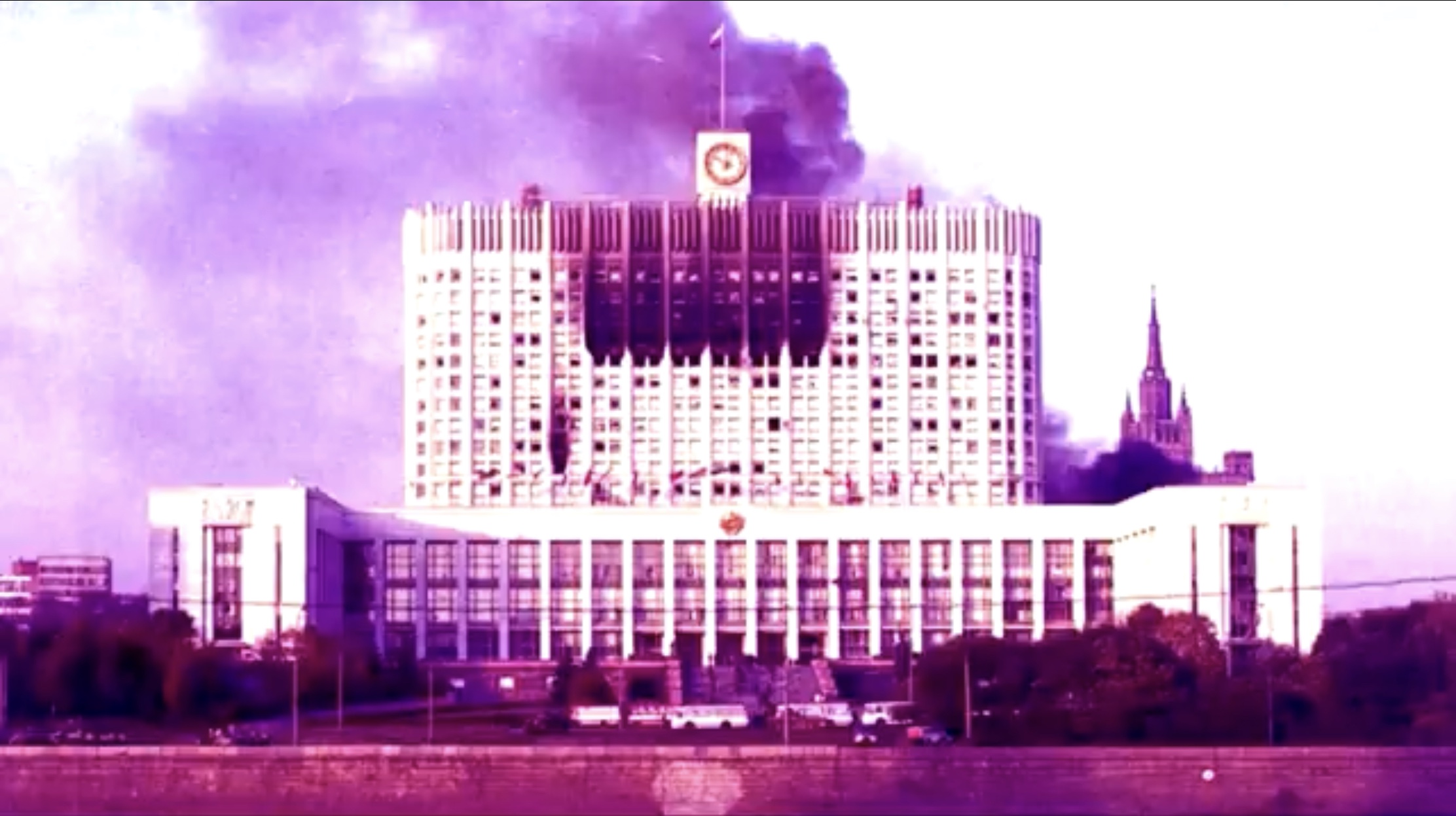
I was searching for music to listen to while I wrote and I came across this:
It’s called “Sovietwave.” As soon as I tapped on the thumbnail (this was on my smartphone) of a purple-hazy photo of the Russian White House (after being shelled in 1991), I was captivated by the aesthetic oddity of the music. Electronic, faded, nostalgic. There is even a man speaking Russian. A comrade, perhaps.
One of the user comments captivated me: “Nostalgic for a future that exists only in dreams.” But I wondered, Why nostalgic? If nostalgia is a longing for the has-been, how can one be nostalgic for what hasn’t been? What is this retroactive constitution of the future—of a future that has not been lived?
Indeed, this is what I found absolutely fascinating: the idea that a certain nostalgia froths up precisely through the new. The new in this case is the electronic “wave,” the synthesizer whose textures are very much reminiscent of the 80s, but which could only have been a product of our contemporary technology. It is almost dialectical. For what this nostalgia that the user quoted above experiences is not actually a desire to return to Soviet culture as it was, but the desire for a “future” refracted via the past. This interest, masquerading as nostalgia for what hasn’t been, is a negation of absence, of the not-present. It seeks to negate the absence of the Soviet alternative (it seeks the negation of the negation) and in so doing, as per Hegel, we move not backwards in time but onwards, towards a new position. A “new” return of the Soviet in these fantasmatic images, these echoes in the Symbolic.
The Urban Dictionary definition of “Vaporwave,” a category of music which I suppose shares the trait of awakening this nostalgia with Sovietwave, says, “people watch Vaporwave as a nostalgic remnant of the past that allows you to truly feel the satire of Post Modernistic (sic) art and culture whilst (sic) also feeling how that Post Modernistic (sic) art is just another by product (sic) of consumerism and capitalism.”
Do we not—and let’s hypothesize we share the user’s sentiment—in the same way sense this double condition in Sovietwave music? Do we not sense this Soviet world as truly lost, as “a remnant,” at the same time that we recognize that this empty nostalgia would have been barred from reality by precisely that which was the most Soviet of Soviet elements: the rigidity and discipline of central economic planning? This means that what makes this nostalgia powerful is, in a paradoxical way, that we don’t truly want it, because a return to the communist squalor of the Soviet 80s would mean the elimination of what allows us to enjoy this nostalgia in the first place. In other words, my nostalgic enjoyment is precisely dependent on the fact that perhaps I know I don’t want to go back to it.
 Ruminations
Leave a comment