One of the things that most fascinate me about “the West” is its occasional patience or even craving for texts that are inscrutable and difficult. Purposefully so, the authors of these texts have been fully aware that their readership would be small, that the feeling that they would inspire in their readers would not be anything better than disgust if not rage (I can, for example, picture a scientific empiricist throwing out Lacan’s Écrits out the window just like Bradley Cooper’s character threw out Farewell to Arms in the film Silver Linings Playbook, a reaction that one can never expect of a Lacanian psychoanalyst who is always too willing, perhaps too much so, to read what new discourses science keeps on coming up with. Indeed, Lacan encouraged his students to read optics, geology, and mathematical topology!). Look at James Joyce. If not Joyce then Gertrude Stein or TS Eliot. The Modernist period produced a whole slew of obscurantist yet very iconic authors. And sometimes not even iconic: David Jones, who wrote the mysterious but fascinating Anathemata remains largely unknown.
This was of course a time of multi-disciplinary experimentation. The early 20th century was the era of Art Deco and Futurism, World War, communism and fascism, New Deals and Leagues of Nations. As many professors of literature might say, it was this chaos, this upheaval that the modernist authors were attempting to capture in their fragmentary works. All of this, I’d argue, comes to a head when in 1939 James Joyce publishes Finnegans Wake, a work of such difficulty that it challenges the notion that one really reads it. One simply traverses it, works through it, maybe, the way a psychoanalyst works through the free associations of his or her patient, picking up a word here or there, making of it a sort of anchor to understand its neighboring surrounds, until by the end, when you have reached an interpretation, what you have done is simply traveled through one path of maybe infinitely many in what truly is a rhizome in book form.
A world war and some decades later, we get in 1973 the publication of Gravity’s Rainbow. The book is far more readable than the Wake but the density of the topics it addresses—archane stuff like the building of the V-2 rocket, the paranoia of Slothrop who thinks the rockets are falling only near him, the intrigue of Second World War-era spy organizations half-playing with occultic media, conspiracy after conspiracy—make of this book a bit of a slog. It is certainly no page-turner and the thrill it gives is really only for those who get a kick out of linguistic subterfuge and mathematics.
But, for me, even more interesting is the publication of “L’étourdit” by Lacan in Scilicet in 1972 (whose translation by Cormac Gallagher I quote from. The translation’s pagination follows both the publication in Scilicet and then the one in the later Autres écrits).1
“L’étourdit,” frankly, like the Wake, challenges reading. Unlike the Wake, however, it is supposed to transmit some knowledge. Why? Because it’s an essay by an analyst so concerned with the methodology and the transmissibility of the knowledge that psychoanalysis produces that he turned analysis almost into a laboratory, a testing ground for the subject to come to be (and for this reason the French philosopher Alain Badiou has said that Lacan is a sort of “antiphilosopher,” a thinker who issues to philosophy “the special challenge of a new object that [the antiphilosophers] say dethrones philosophy’s established pretensions, since philosophy has forgotten ‘about’ or dispensed with investigating this object”2).
Lacan moves, then, beyond Joyce. For what Joyce does is art. Joyce has no intention of teaching or transmitting knowledge. He is doing whatever artists do. But Lacan is producing formulas, he’s producing a discourse of “ab-sex sense,” he’s inscribing in the interstices between sense and non-sense the real which is the non-existence of the sexual relationship.3 To make linguistic sense, it is required that you cover up the fundamental fact that the sexual relationship is absent. As Lacan says, “every subject as such, because that is what is at stake in this discourse, is inscribed in the phallic function to guard against absence of the sexual relationship (the practice of making sense, is precisely to refer oneself to this ab-sense)” (15, 459). So to make us aware of this lack, which cannot happen using common sense, Lacan opts for this bizarro ab-sense.
A crucial move is to say that the negation of sense may include more than absolute negation, that there is, as Cassin says, a “less than nothing”4 or, as Badiou says, an “out-of-place”5, a gap which is neither in sense nor in non-sense and which is the real of the lack of the sexual relationship. And because this gap avoids sense, it is untouched by the register of the symbolic, by the Big Other which is the order of signification and meaning. In other words, the gap that is ab-sex sense is the hole beyond the symbolic, the impasse. All speech about the sexual relation is thus not about the sexual relation: it merely gets us to the hole it is.
Barbara Cassin, as she argues in her dialogue with Badiou, leaves little ambiguous confessions of her trials in understanding Lacan.6 She wrestles with it. Like the Wake, “L’étourdit” challenges what it is to read, what it is for the eye to glide over the letter and accept. Indeed, what is it that is sought from a passage such as this one?
The riddle of the notall
But where the notall (pastouts) has just said that it does not recognize itself in them, what does it say if not what it finds in what I brought to it, namely:
the quadripod of the truth and of the semblance, of enjoying and of that which from a surplus—, slopes away having failed to protect itself from it,
and the bipod whose separation shows the ab-sense of the relationship
then the tripod which is restored by the re-entrance of the sublime phallus which guides man toward his true bed, the one he has lost his way to. (24-5, 467-9)
And how can knowledge at all be transmitted here? Knowledge is of supreme importance for a theoretical enterprise which has suffered since its foundation to answer for whether it actually works! Like Marxism, psychoanalysis is fraught with its own practical ambition and theoretical rigor. It is as if both theories—the two which have most seriously challenged the regime of bourgeois complacency, had actually come to the impasse, to truth, to the sun of what is and in its blinding, awesome glare were burned to a crisp.7 So that what else could have appeared in history but that their legions of devoted apostles would be doomed to witness their theories evolve into totalitarian states and bureaucratic international schools. Or into a babble. An endless babble utterly vanquished by the electric pulses of capitalism which has even gone so far as to accommodate the symbols of Marxism and psychoanalysis into its order. After all, it’s very easy to buy a Mao suit on Ebay, and you can make a quick buck nowadays by publishing books in which all you say is that Donald Trump has daddy issues.
Anyways, my point is that knowledge is a serious business for the psychoanalyst. And to teach the juniors in the field means that there must be something to teach. And yet, here’s babble in “L’étourdit.” Here’s lalangue. Fifty pages of it.
Have I understood it? Not by a longshot. It is a performance, in the end. As Cassin says, “ab-sense is located right within the relationship between performance and signifier” (39): it has to be a performance, it has to be an exemplar of that confounded logic you find where the phallus of Aristotle doesn’t reach: in ab-sex sense—in the impossibility of speaking, of singing about the relation. Indeed, why is it that wise men say you can’t rush into love? Where should I stay and why would it be a sin to fall in love with you? So it goes, says Elvis. It’s so important to us and yet we speak so poorly of it.
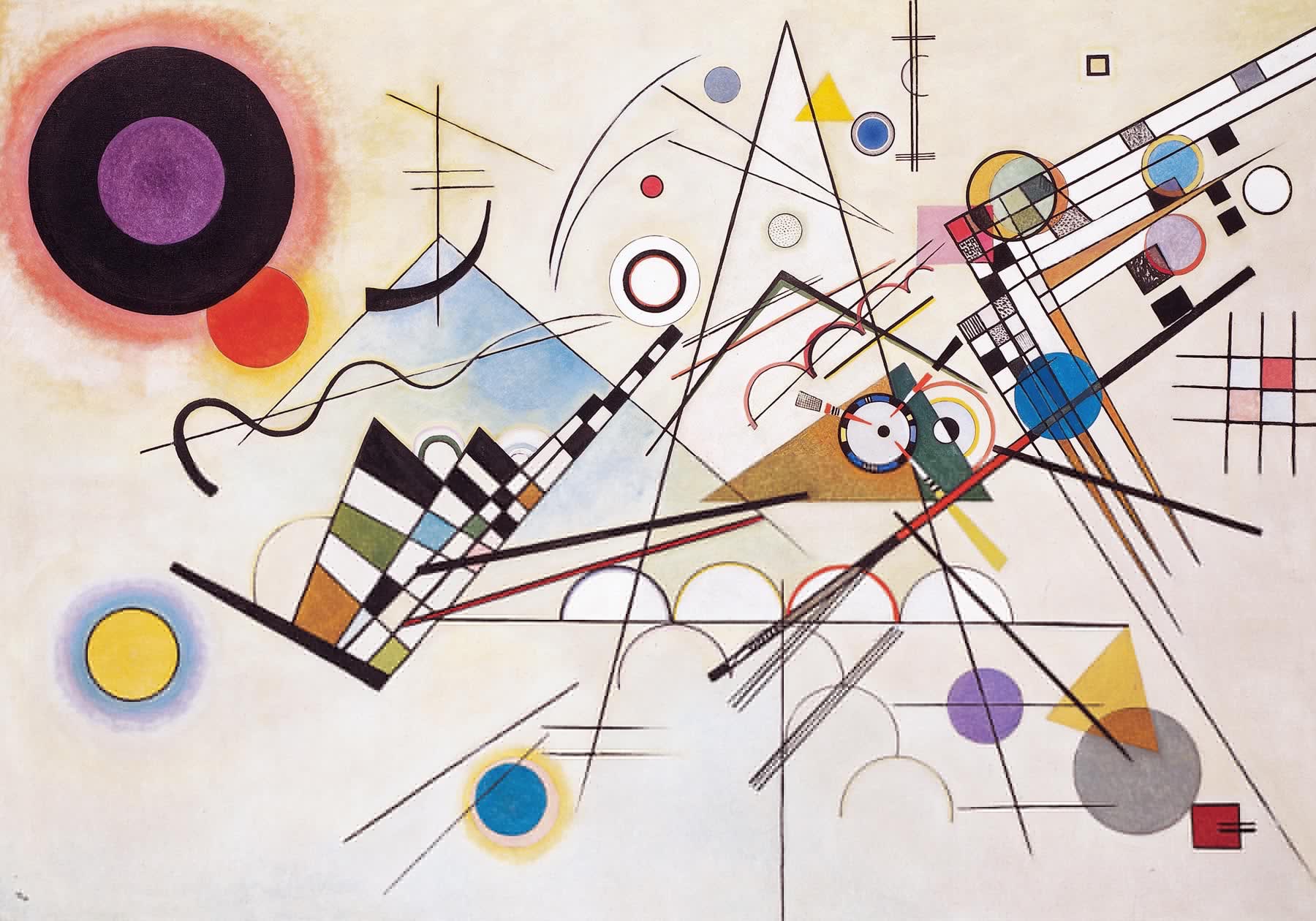
Cover art: Composition III by Wassily Kandinsky
- http://www.lacaninireland.com/web/translations/ecrits ↩︎
- Badiou and Cassin, There’s No Such Thing as a Sexual Relationship: Two Lessons on Lacan, New York: Columbia University Press 2010, p. 48 ↩︎
- “[L]ack-of-sense (ab-sens) designates sex: it is by the inflation of this lack-of-sex-sense (sense-absexe) that a topology is unfolded where it is the word that decides” (Lacan, [8, 452]). Perhaps more simply (and reductively), Slavoj Žižek writes that this provocative, pervasive, yet elusive phrase means: “the relation between the sexes is by definition ‘impossible,’ antagonistic; there is no final solution, and the only basis for a somewhat bearable relation between the sexes is an acknowledgment of this basic antagonism, this basic impossibility” (Slavoj Žižek, The Sublime Object of Ideology, London: Verso 2008, p. xxviii). ↩︎
- Badiou and Cassin, p. 34 ↩︎
- ibid., p. 58 ↩︎
- “For once, I understand everything (I think) about the intertwined strands and the overall disegno” (26). See also p. 39. ↩︎
- In fact, could this be a privilege of the two theories: to have to constantly confront their own limits? Can capitalism say the same? Are not the current global crises precisely the product of a capitalism that has not dealt with its own negativity, that has not stopped one minute to criticize itself a little? ↩︎
 Ruminations
Leave a comment