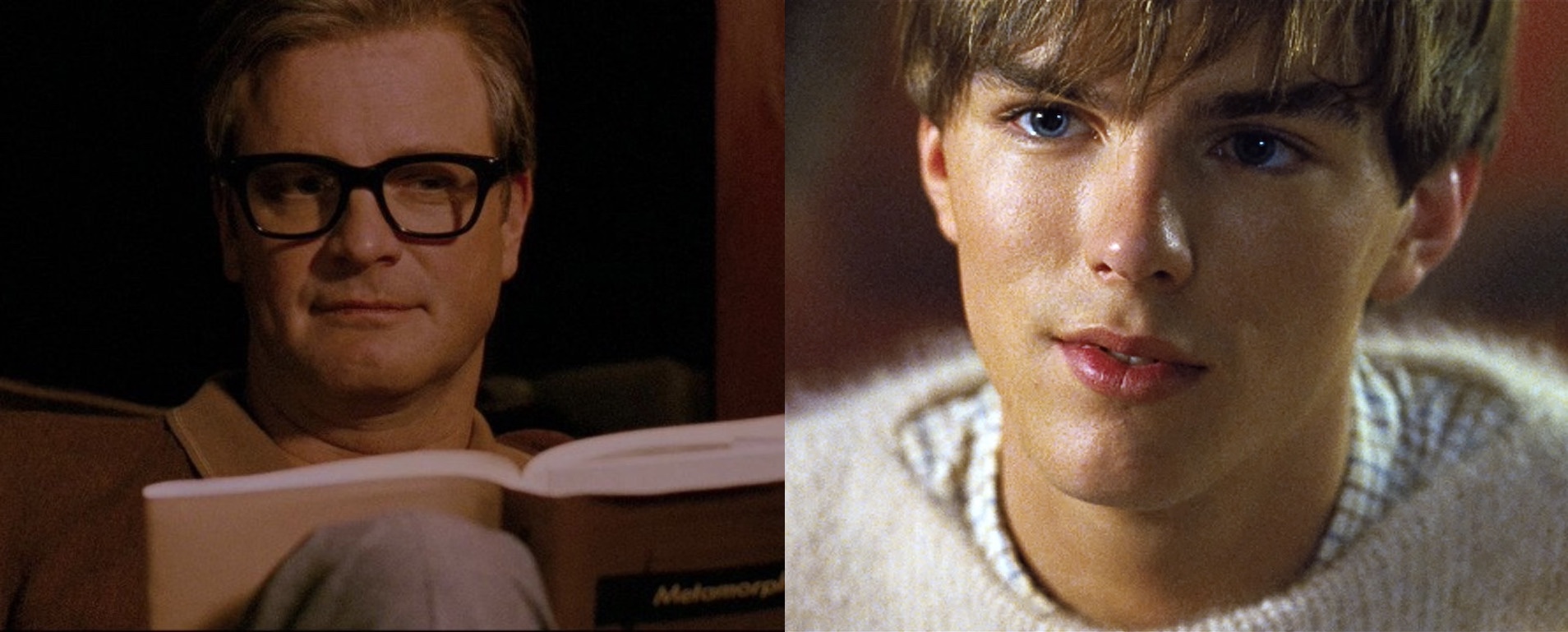
The story is an existentialist plight. George, the college professor, tries to deal with the loss of his partner, Jim. The film is absurdly beautiful. Directed by Tom Ford, it shows us what is cinematographically possible when a man with an eye for visual detail writes, produces, and directs an adaptation of a very subtle book. The costume design is so beautiful it can be distracting. Tom Ford suits, cashmere sweaters, crisp linen shirts, shoes polished like black onyx. It’s certainly a bit different from the novel where George seems, well, a bit poorer. He lives, for example, in a “tightly planned little house”:
“Think of two people, living together day after day, year after year, in this small space, standing elbow to elbow cooking at the same small stove, squeezing past each other on the narrow stairs, shaving in front of the same small bathroom mirror, constantly jogging, jostling, bumping against each other’s body by mistake or on purpose, sensually, aggressively, awkwardly, impatiently, in rage or in love.”1
The adaptation takes its liberties. Jim is far more “human” in the film. In the novel, he is only an echo, the mark of George’s loss (of lack, to use Lacanese). As a result, George is lonelier in the novel, more bare. The life of the film’s George is sumptuous, luxurious. Kenny, the boy who captures the professor’s eye on his last day of life, is far wiser in the film. There is more parity between George and Kenny when they talk at the bar. In the novel there is a trace of naiveté, of silliness, the effect of which is that Kenny seems more innocent, more immature. Strangely, the result is that the film seems more pompous because of its aesthetic perfection.
The two Georges that reach their absurdist peak are not the same at all. The George of the film plans to commit suicide. He has his gun, has prepared himself for it, has even left some money for his housekeeper. The George of the novel has opted for no such thing.
This is paradoxical, for it is Ford’s George that is surrounded by luxury and beauty and is himself beautiful. And yet he’s the one who chooses death. Isherwood’s George, on the contrary, is simply living a day of tremendous emptiness. Indeed, the events of the novel and the film both happen in 1962, when the world came close to nuclear catastrophe over an island in the Caribbean. So it too is a world on the verge of collapse. And for all of this, it is the novel’s haunting simplicity that makes it more tragic. From Korzeniowski and Umebayashi’s transcendent soundtrack to the sumptuousness of the fashion, the film is too aesthetic, too beautiful for the cry of existential anguish to be heard.
Sure, one could always say that such was the grief of the film’s George. It was potent enough to destroy him past any and all worldly beauty. But what’s interesting is that this George is ultimately convinced not to take his own life. Ultimately, in the film as in the novel, George ends up dying by heart attack, perhaps the most Romantic if not symbolic of deaths to appear in fiction. I see this as Ford trying to reinscribe tragedy, trying to keep his loyalty to the simple chaos in Isherwoods’s novel. Perhaps he thought he had gone too far and ended up stumbling upon an ending which he must have seen was against the grain of Isherwood’s vision.
I came to the book after watching the film and after having read another of Isherwood’s books: Christopher and His Kind. This was the memoir of his very gay time in Weimar Berlin. Loves and jealousies and frolickings are all depicted there and what truly stands out is the precision with which Isherwood portrays the subtleties of desire, of gay desire.
Written in 1964, A Single Man comes almost four decades after his travels in Germany before its fall to Nazism. It was written in America, in golden, idyllic California, the very same of which Theodor Adorno had so much to say. The reason I mention this is historical: Isherwood is considered by some—at the very least, by Edmund White, who left a blurb on the back of my paperback—to have written “one of the first and best novels of the modern gay liberation movement.” In other words, Isherwood is a figure who bridges for us the queer glory of Weimar Berlin and our modern civil rights movement.
The rise of the Nazis meant the end of a burgeoning queer culture in Berlin. Robert Beachy writes, in his fantastic book Gay Berlin, that Dr. Magnus Hirschfeld, founder of the Institute for Sexual Science and pioneer of the field of sexology, “identified fifteen bars and taverns, and he claimed in 1914 to know of at least thirty-eight Berlin establishments that catered primarily to homosexuals and lesbians.”2 Furthermore, “Hirschfeld and his medical colleagues also pioneered some of the first primitive hormone treatments and sex-reassignment surgeries, effectively creating a nascent science of transsexuality.”3 As Isherwood provocatively writes in Christopher and His Kind, “To Christopher, Berlin meant Boys.”4
After Hitler’s election in 1933, Nazi gangs ransacked most of these establishments, burnt records, and… well, you know the sordid rest. It was tragic. An entire culture was lost, an indication, if there ever was one, that not only could “progress” be stopped by reactionary zealotry but also vaporized. Even as Berlin clawed itself out of the rubble of World War II, it never saw the openness of sexual expression it had seen in the 20s again. “During the Third Reich more than 100,000 German men were charged under paragraph 175,”5 writes Beachy, “and of these an estimated 5,000 to 15,000 perished in prisons and camps.”6 But, after the war, and “[l]ed by the conservative Christian Democratic Party, the Federal Republic of West Germany preserved the more draconian Nazi version of Paragraph 175 for a period of twenty years.” In East Germany, they stopped the prosecution of men over eighteen in same-sex relations only after 1957.7
Isherwood’s A Single Man is, in a way, the confluence of two historical epochs making contact and I would say that its subtlety and its quiet melodrama is perhaps the product of Isherwood acclimating to a society of, as he tells us, “Coke-drinking television watchers.”8 It is also the product of his aging, of being at that point in life when one begins to see that being the object of desire is no longer quite a certainty, that you now have to labor to find the beauty that blossomed so naturally from youth.
But there are redemptions. There is “wisdom,” whatever that entails. (“I’ve been through this and that; and when it happens again, I say to myself, Here it is again. But that doesn’t seem to help me,” says George.9) It is at the end of the novel, in his conversation with Kenny, that George gives us a fascinating philosophy of intersubjective speech: both George and Kenny are drunk and “He tries to describe to himself what this kind of drunkenness is like. Well—to put it very crudely—it’s like Plato.” It is a “dialogue.” “[W]hat really matters is not what you talk about, but the being together in this particular relationship.” Interestingly, as if Isherwood had been doing some Lacanian reading, he writes:
“You and your dialogue-partner have to be somehow opposites. Why? Because you have to be symbolic figures—like, in this case, Youth and Age. Why do you have to be symbolic? Because the dialogue is by its nature impersonal. It’s a symbolic encounter. It doesn’t involve either party personally.”10
This dialogue we’re having, it is already the Other, something Lacan had been saying since the 1950s.
All of this being thought by George and he condescends a little to Kenny because he thinks it’s all so complicated that Kenny wouldn’t understand. And he doesn’t want that. He wants Kenny’s secret, his agalma. “More than anything, he wants Kenny to understand, wants to be able to believe that Kenny knows what this dialogue is all about.”11 And George begins to feel that he does. That the underground current of desire is running in the words, in the dialogue. So what does George ask of Kenny? The most psychoanalytic thing possible:
“Say something,” he commands Kenny.
“Do I have to?”
“Yes.”
“What’ll I say?”
“Anything. Anything that seems to be important right now.”
George is aware of the importance of speech, of communication, and particularly of its coding. Is not the cipher, the code, precisely that on which gay cruising depended during a time when this form of love, to use Lord Alfred Douglas’s words, “dare[d] not speak its name”? Aren’t we supposed to read George’s outburst (“Don’t you have a glimmering of how I must feel—longing to speak?”12) as a neurotic outburst, a moment of acting out? His students call him cagey and reserved, but the truth is that he is like this because of them, because of their America, which, despite its involvement in lancing the disgusting abscess that was Nazism, still fell short of its promise of full freedom. After all, how many in Isherwood’s time would have defended the idea that the right to pursue happiness includes the freedom to love? And was not this fear of the homosexual a component of what energized the Nixonian-McCarthyist paranoia?
George wants, in the end, the circuit to close: for Kenny to understand his desire, that he desires him. That he has to desire him because Jim is gone.
George dies in his sleep. A heart attack caused by an atheromatous plaque which began to grow at the precise moment—and you have to love the romance—when his eyes first set on Jim years ago.
Cover: Colin Firth as George Falconer and Nicholas Hoult as Kenny in Tom Ford’s A Single Man
- Christopher Isherwood, A Single Man, New York: Farrar, Straus and Giroux, 2013. ↩︎
- Robert Beachy, Gay Berlin, New York: Vintage Books, 2014, p. 59. ↩︎
- Ibid. 163 ↩︎
- Christopher Isherwood, Christopher and His Kind, London: Vintage, p. 3. ↩︎
- Paraphraph 175 of the Prussian Imperial criminal code of 1871 contained an anti-sodomy statute. It was this paragraph that Dr. Magnus Hirschfeld made the object of his political protests in the early 20th century. ↩︎
- Beachy, p. 245 ↩︎
- Ibid. p. 246 ↩︎
- Isherwood, A Single Man, p. 18. ↩︎
- Ibid. p. 160 ↩︎
- Ibid. p. 154 ↩︎
- Ibid. p. 155 ↩︎
- Ibid. p. 174 ↩︎
 Ruminations
Leave a comment