(Talk given on November 5th, 2020, at Miami-Dade College, West Campus, online; part of the “Dare to Dream in the Anthropocene” series sponsored by The Humanities Edge)
The Factory and the Gaze of the Animal
Let me begin this talk by remembering an old video I saw of a hyena devouring a wildebeest alive. I think it was captured by a safari group, so you could hear the comments and reactions of the safari goers in the background. The wildebeest is alive as the hyena bites and chews her way through the hind of the animal. The wildebeest seems resigned to its fate. And the hyena, too, in a way, is diligent in eating, quick and perhaps even efficient as she tears through her prey’s flesh. Then, it happens: the hyena bites into some organ or tendon or a nerve and the wildebeest, which until that point had simply bore its fate with stoic resignation, jerked up and bellowed and shot its legs and hooves up into the air. And then it was over. The voices behind the camera expressed their shock at the moment. There were gasps and someone cries out to the person next to them in horror. It was a moment in the video which shows us that the pain of the animal can be our pain, that we know suffering when we see it, and that this pain and suffering, even when it occurs on an African savannah, where it is a “natural” part of life, where it has its place, is something we inherently dislike.
The video is likewise interesting to me for the reason that what the video showed was a scene that is often always censored in nature documentaries, like those famously narrated by David Attenborough. Are you aware of this? Let’s say the documentary is about a lioness and her cubs struggling to find food in the savannah one summer. Maybe it’s too dry or there is a lot of competition or maybe there’s a roaming male around that may threaten her cubs. She’s teaching them to hunt and there are some early failures until finally they catch a zebra and momma lion and cubs go to sleep with their tummies full and happy. And, of course, the documentary will not show the last moments of life of the zebra, its last pains, nor the bloody muzzles of the cubs. The camera will cut away.
It’s an indication, I think, of ideology, in the Žižekian sense. The success of documentaries such as these is owed to the way in which the arbitrary lives of animals are anthropomorphized. What Attenborough does is to give them motivations, desires; the narrator’s voice dramatizes their struggles and in so doing he draws the viewer into a narrative with which they can identify. The result is a story we find appealing. We discover a kinship with the animal. We say to ourselves, “You see, they are just like us,” “Their struggles are our struggles,” and thus you arrive at the conclusion that we are indeed one family, co-habitants on this beautiful warming Earth.
The problem with this, of course, is that this reaction is an egregious vanity, not least because of the already filtered nature of what we observe in the documentary. What you’re really seeing is a natural process—lions hunting—covered over with a narrative and censored. But also because our reaction, our pleasure, which is precisely what the documentary wants to elicit so that you can find it within yourself to donate to the World Wildlife Fund, is precisely a feature of the anthropocentrism that Jacques Derrida thinks is a founding philosophical gesture. Meaning: that for philosophy to start, for Western thought to become what it is today there had to be an animal we displaced, an animal in whose sight—or shall we say, from whose sight—we had to fall as did Adam and Eve when confronted by the snake so that civilization could begin; the anthropocentrism that the bioethicist Peter Singer renames as “speciesism” and that he sees as the cause of, among other things, the modern animal holocaust which is factory farming. We do not see the lions as they are in their cruel dignity. No, we have to go ahead and see mothers and children and education and breakfasts and yes a little of labor and its reward. We see them as us; in them we see us, and what is this action if not the neutralization of the gaze that was already there.
This is Jacques Derrida’s point of departure in The Animal That Therefore I Am1 and it is what I’d like to talk about today: what has the animal meant for our thought, and how is it that it is during the most modern period of human civil rights, the period that saw the lengthening of human life expectancy, that we also find the spread of factory farms.
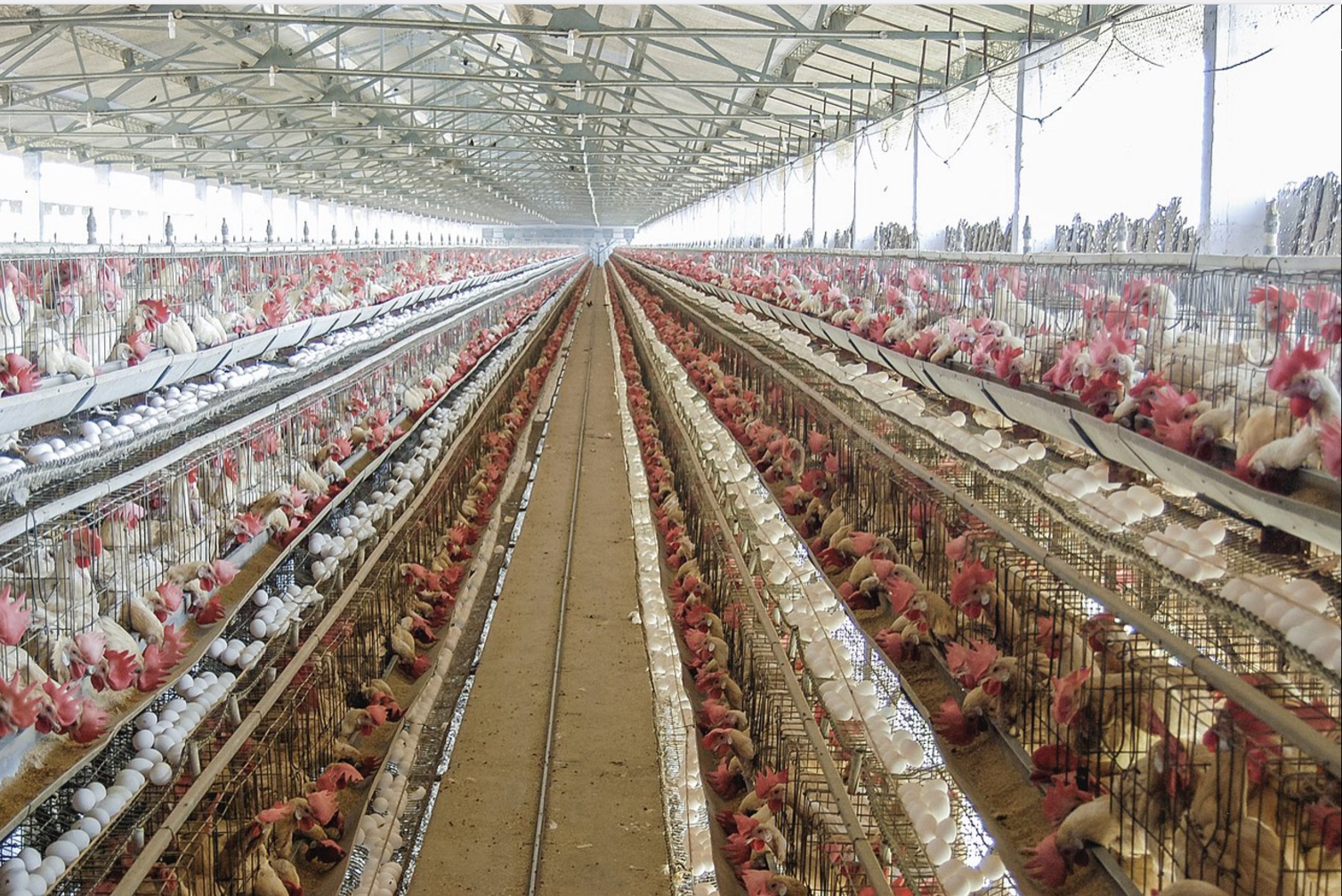
In these farms, animals have been subjected to incalculable suffering. Techniques have been invented and perfected for the mass production of meats, dairy, and eggs, none of which take into account the comfort of the creatures, and which are designed to maximize, as Peter Singer reminds us often in his great book Animal Liberation,2 the profits of the producers, the farms, and corporations like Tyson and Perdue. Indeed, as Derrida and Singer both recognize in their own ways, something has been happening for a long time: the forgetting of the animal. We learned to like cheese and egg biscuits too much and we forgot that hens like to lay their eggs in privacy, that they cannot do so when there are five other chickens in a cage so tight that none can comfortably flap their wings. And so they retain their eggs until the pain becomes so unbearable that they are forced to lay them.
What I want to question, with Derrida and Singer, is this omission, this forgetting. I want to find the gaze of the animal. I want to have it in front of me and I want it to be there and to let it be there. For what we find, is that this action, this letting be—which is a phrase full of Heideggerean implication, and Heidegger was ultimately not very nice to the animal—is something the philosophers have never done, that the BBC Documentaries will not do, and that even we hesitate to do perhaps because many of our enjoyments depend precisely on this forgetting of the animal. Again, who wants to think that a delicious chicken nugget was once a chicken drenched in the feces of the fifteen other chickens that lived in the cages above it or that the fancy veal you find in high class restaurants is the atrophied muscle of an infant cow separated from its mother and kept starved so that its flesh remains tender and pale?
In The Animal That Therefore I am, Derrida writes:
“The animal is there before me, there next to me, there in front of me—I who am (following) after it. And also, therefore, since it is before me, it is behind me. It surrounds me. And from the vantage of this being-there-before-me it can allow itself to be looked at, no doubt, but also—something that philosophy perhaps forgets, perhaps being this calculated forgetting itself—it can look at me.” (11)
Philosophy is maybe “this calculated forgetting itself.” He writes this passage in the same chapter where he describes what he feels like when he walks into his bathroom and his cat follows him and gazes at him in his nudity. This gaze is “bottomless,” as he says, it is “abyssal,” it is a sort of limit or border. This shame that he feels becomes the moment for a Derridean meditation on nudity, on how, at least in the Judeo-Christian tradition, it is the shame of nudity that marks the psychological consequence of the fall of man. And he recalls that the moment of the fall, of Adam and Eve’s fall was caused in light of, in the gaze of an animal that saw them in their nudity: the serpent.
So: Derrida is in front of his cat who gazes at him. He sees himself being seen by a gaze that he describes as “bottomless,” as being the “vantage” from which “man dares to announce himself to himself” (12). Derrida goes so far as to call this a “bordercrossing,” which is for us a term rife with sociopolitical meaning. A border, a separation which is enforced, a difference that delimits in whose terrain we find the baton of the police and the cut of identitarian difference. Indeed, for Derrida, this gaze and the shame that it causes in him is what gives us a clue regarding the fragility of this border. For it is not a separation that causes Derrida to feel pride. He does not stand naked in front of his cat and feel proud of himself. He does not see his humanity—or perhaps even his masculinity validated, emerging triumphant; quite the contrary, it is nausea and anxiety he feels.
Derrida calls this moment an apocalypse. He is “like a child ready for the apocalypse” (12). So this little creature in his bathroom is the apocalypse, which is by no means something bad. Quite the opposite. Derrida sees his little cat, her gaze, as being what ends the human, what delimits him as man. And yet, as he points out to us, that border between animal and human is very porous, it is folded upon itself, it is a difference comprised of many differences like the bolgias that you find in the eighth of Dante’s infernal rings.
And of course, what this all means, is that the division itself is not quite as clear-cut as you’d think. As most of philosophy would have it, what separates you from a cow is that the cow cannot do long division. Where, then, does the human begin and the animal end? At what point does the difference become truly valid, especially as it concerns the issue of the distribution of rights? Does a baby, a severely mentally impaired baby differ from a normal animal? Without using religious dogma, what is it that separates the human from the animal? On what theoretical point, on what principle, could we rely to justify, for example, putting the carcass of a baby cow on a billionaire’s plate and not the carcass of a baby human?
This is Peter Singer’s question. He is a bioethicist so he comes from a tradition very different from Derrida’s, who is a post-structuralist philosopher. But what’s interesting, is that he reaches not just the same conclusions but almost the same terminology: that of the boundaries, of the borders between human and animal. Singer realizes that when it comes to rights, the borders between human and animal are very ambiguous at the margins where you find those human individuals that for biological, genetic, and/or organic reasons simply do not fall under the Enlightenment paradigm that what makes a subject a subject is the capacity to use Reason to take independent action. “I eat pork, because a pig is not like us,” you might say (and notice how we call the carcass a different name; we don’t say, “I eat pig”), but in what way? In what way is this pig different? Because the pig cannot speak? Because he cannot use language? Because, again, he cannot solve an equation? Because he cannot sign a mortgage? Because he doesn’t have Reason and is just, as Descartes believed, a machine-like automaton that can only react? The truth of the matter is that when you’re eating the ribs of a pig or the beef in a whopper or the breast in a nugget you’re not thinking of the fact that it was once a living animal and much less of the ethical quandaries that this action presents, nor of the fact that, as Singer pointed out, there is no ethical argumentation that would, on the one hand, protect all humans by giving them truly inalienable rights regardless of mental capacity, and on the other, justify the murder of animals for food.
Indeed, Peter Singer takes from Jeremy Bentham, a 19th century utilitarian, the idea that it is a being’s capacity for suffering—and this alone—that is the basis for us to see their interests as equal to ours. Singer’s emphasis on pain here gives us the opportunity to connect him to Derrida and particularly to Derrida’s concept of the animal gaze. One section of Singer’s book is dedicated to describing some of the excesses that we find in animal testing. Animal testing is something that has been done since the era of Descartes—who, as I said, believed animals were machines and so you could say that he set the moral tenor for an an age in which natural philosophers nailed dogs to the wall and cut them open alive to increase their anatomical knowledge. More recently, a practice that is notorious in the animal-rights community is the Draize Test: a procedure in which chemicals used in pharmaceutical products like hygiene products or cosmetics are dropped into the eyes of rabbits or rats so that scientists can observe the degree of irritation caused by the chemicals. As Singer notes, the tests are useless for various methodological reasons (Singer 57, 72), but they were widely executed.
What I find interesting about it is that the Draize Test is an instance in which what the human does is literally destroy the gaze of the animal. Derrida’s concern, a metaphorical one to be sure, sees in the Draize Test a physical realization. A scientist destroys the eyes of the animal and measures, precisely, their suffering. As Theodor Adorno and Max Horkheimer wrote in Dialectic of Enlightenment,3 “the rabbit does not represent but, as a mere example, is virtually ignored by the zeal of the laboratory” (10). What they mean here is that science has reduced or “petrified” the objects of its interests so that they are always interchangeable within its networks of meaning; in other words, unlike in ancient sacrificial societies where animal sacrifice represented something special, in modern scientific society nothing is valued for itself: “the rabbit does not represent” itself. That is, I think, the word they missed in that quote: itself. This rabbit I kill today in the name of science, I will forget tomorrow as I kill another.
But this is supposed to be a talk on the Anthropocene, on climate change, on the effect, I suppose, that this attitude towards animals, which has been in our collective psyche since the Book of Genesis told us that God was a carnivore (otherwise Cain wouldn’t have killed Abel) has had on on our warming globe. Indeed, if we leave aside the inhumanity that the Scientific Revolution caused to descend upon our unwitting furry, feathery, and scaly friends this still leaves under discussion the calamity that is factory farming. For if Adorno and Horkheimer were afraid that we were no longer considering rabbits as subjects but rather pure objects, I wonder what they would think if they’d heard Fred C. Haley, the president of a Georgia poultry firm that controlled the lives of 225,000 laying hens, when he said, “The objective of producing eggs is to make money. When we forget this objective, we have forgotten what is is all about” (Singer 107). I wonder what they would think if they’d read that the US Department of Agriculture condoned the practice of tail docking pigs and even recommended to “[c]ut tails 1/4 to 1/2 inch [sic.] from the body with side cutting pliers or another blunt instrument. The crushing action helps to stop the bleeding” (Singer 121). I wonder what Adorno and Horkheimer would think if they’d heard what a pig producer said in response to the procedure: “They hate it! The pigs just hate it. And I suppose we could probably do without tail-docking if we gave them more room” (Ibid. 121). What would they think if they’d read what another capitalist, in the magazine Hog Farm Management, said in 1975 to justify the conditions in which pigs live: “What we are really trying to do is modify the animal’s environment for maximum profit” (Singer 123)?
In 1965 (an important year for civil rights in America, indeed!), the Brambell committee, which was a committe appointed by the British Ministry of Agriculture, published a report that contradicted the ludicrous argument then being uttered by industry professionals that said higher productivity—meaning fatter, girthier animals—was a sign that the animals weren’t suffering. Furthermore, seeing the horrible conditions in which animals were raised in factory farms, they recommended that the animals not be confined, that they should be 1) free to be able to turn around, 2) to groom themselves, 3) to get up, 4) to lie down, and 5) to stretch their limbs. These came to be called the five freedoms. As you can imagine, the fact that these had to be recommendations shows you precisely what was not available to animals at factory farms. In fact, the European Union has said, that the minimum living space required for chickens at factory farms be about 120 square inches (which is roughly the area of a wider-than-normal letter sized sheet of paper), but the space that is often found is 48 square inches which is about the area of a large index card.
Indeed, a good majority of the problems in factory farming stems from how cramped the animals live. As the industry sees it, the more animals you have per square foot the more profit you make. Thus, in order to save up space as well as to curtail the anxieties and “vices” that this boring confinement causes in the animal, many farms resort to mutilation: they debeak chickens, dehorn cattle, and dock the tails of pigs. All of these procedures, as I’ve read, are awfully painful. And all of them are, as of today, and to my awareness, legal.
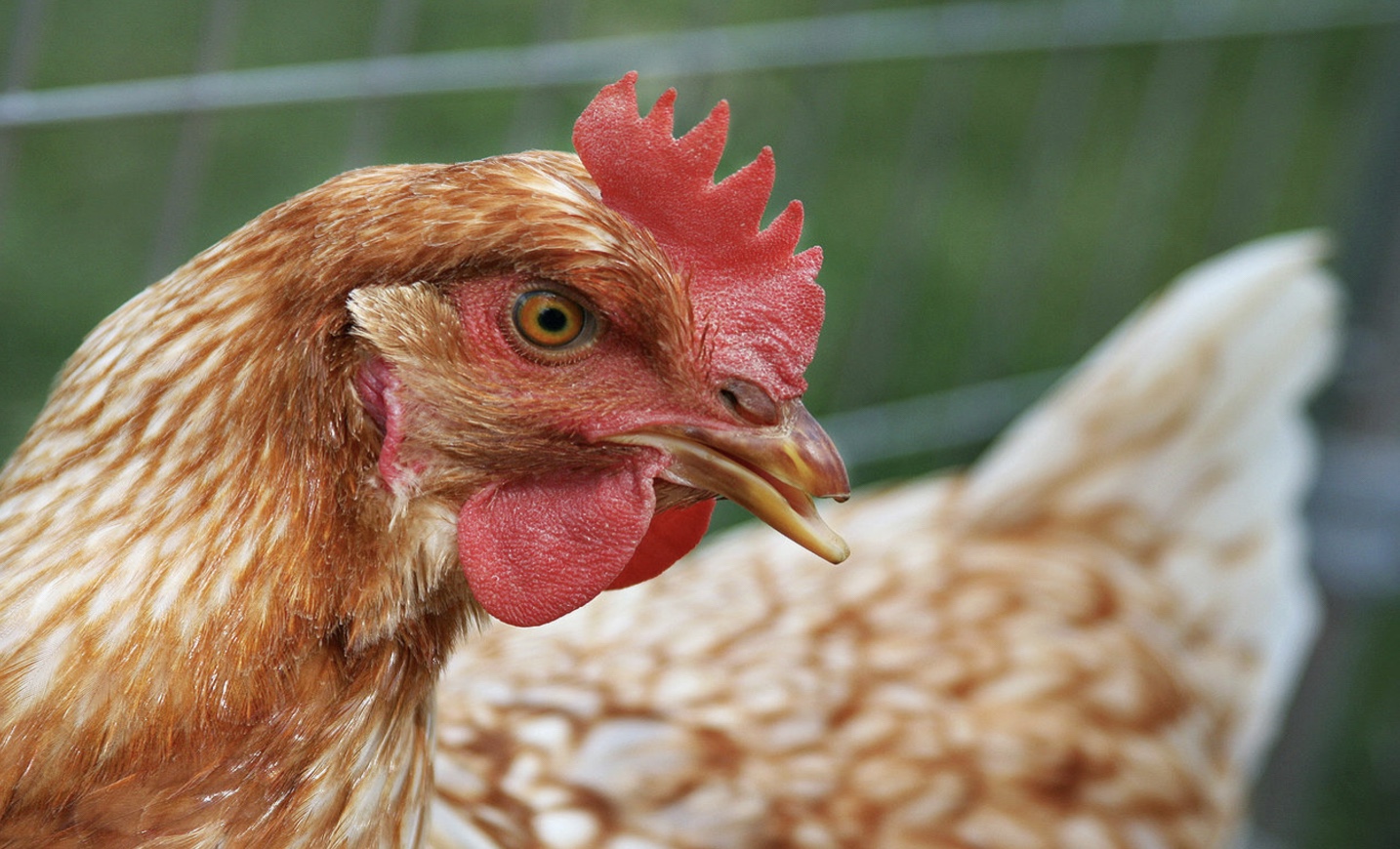
The same principles of craven profit maximization are still at work and particularly now at a time in which the chicken industry, for example, sees itself needing to slaughter 9.5 billion chickens a year to meet consumer demand. The number is enormous. And when each broiler farm holds tens or hundreds of thousands of chickens, you can expect that the chickens are not being given proper care.
We live in a world, to speak frankly, that only pretends to care about animals, seeing as how this same world is all too keen to justify the abuse—or what Derrida calls the “medico-industrial exploitation” (80)—of pigs, cattle, chickens, turkeys, rabbits, mice, minks, and so on by hiding it and veiling it behind our concern for comfort and so-called “higher standards of living.”
Following Adorno and Horkheimer, this phenomenon—this killing of nine and half billion chickens a year—can only be possible in a world that sees the animal as a pure object, as a being totally separate in nature from the human because it is devoid of the capacity to reflect and cognize, to hope for the future, to be responsible for itself. It is not a zōon logon echon. As Derrida tells us, René Descartes, the father of modern philosophy—or rather, modern philosophical discourse—already begins to show this prejudice in a letter of his from March 1638.4 There Descartes tries to delineate the difference between human and animal psychology. He’s interested in doing this to reject the claim which says that because humans’ organic, biological behavior—such as how we respond to stimuli like pain or pleasure—is similar to that of an animal, then our psychologies are similar as well. Instead, to prove it wrong, Descartes comes up with a thought experiment, what Derrida calls a “methodological fiction” (79) in which Descartes asks us to imagine a world without animals, a world where instead of animals what you have are simply machines that behave like them. The question—of course, a very Cartesian question—is: Would we know the difference? Would we know the difference between the animal and the automaton?
Derrida sees in this hypothesis, despite its methodological or pedagogical value, “a spectacle that is more plausible today than in the seventeenth century” (80). Indeed, is it any surprise, as we head into an age of no animals, of more and more extinctions, into what some are calling the Sixth Extinction,5 that the father of modernity himself had already imagined a world without animals so that he could thereby establish in argument the psychological supremacy of the human, the animal rationale? Is it thus surprising that a century later Kant said animals were “things” because they could not think and thus rendered them into objects to be dominated (Derrida 92)? Or that Heidegger considered the animal as “poor in world” (Derrida 79)? Indeed, the National Hog Farmer wrote in 1978, “The breeding sow should be thought of, and treated as, a valuable piece of machinery whose function is to pump out baby pigs like a sausage machine” (quoted in Singer 126). This is, in many respects, the prevailing attitude to this day.
This whole situation is all the more understandable considering the ecological crises we are confronting. Aren’t we where we are today because, on the one hand, we simply don’t give thought to the natural world and our animal others—especially when doing so would conflict with our enjoyments; and on the other, because the profit motive is still a categorical imperative in global society?
This lack of care, this avoidance, this non-seeing, this blindness—which, by the way, is self-imposed because, as the conspiracists say, the truth is out there—is now even a factor of global warming itself. Livestock factory farms now contribute up to 14.5% of all greenhouse gas emissions. Their emissions can also comprise up to 37% of global methane.6 It is also the source of natural pollutants. Where do you think the waste of billions of animals goes if not into the rivers and water supplies?
Not only that, but the amount of vegetable food that is needed to maintain these animals and to fatten them up before the slaughter is enormous and continues to strain our resources. For every kilo of meat, you need many more kilos or animal feed. And to grow this feed you need water, fertilizer, and, of course, labor. As Vaclav Smil (2000) wrote in his book Feeding the World: A Challenge for the Twenty-First Century, this is far from sustainable, let alone the fact that it is also far from humane. People are going hungry in the world and yet we continue to cut down forests to make room for more livestock raising. By all objective accounts, our future does not seem bright. And if Derrida and Singer teach us anything it is that this worsening condition is not an illness whose social or economic symptomatology we can heal and be done with it but is the product of a treatment, of a relationship with the world that is ideological. It is ideological because it operates without our questioning it, because we simply assume that this relationship is part of reality as such; we do not question the claim, for example, that says animals are fundamentally different from us, because that would make difficult a lot of what we do in the world and to the world. Again, if what you desire all your life is a Ferrari with leather seats, will the fact that those seats are covered with the skin of a calf stop you from buying it? And by this I of course don’t mean to imply we are equal to animals (though, I want you to notice, as Derrida did, that in our language, to say one is an animal is to say on is something bad, though in my opinion it is the animal who is often the noble and honest one). I do not mean to say we are equal anymore than one human and another are existentially equal, though they are equal in rights and possibilities; rather, the interests of animals should matter as much as ours, that our interests are equal. We both want to live and move and breathe. We should treat them as we treat each other.
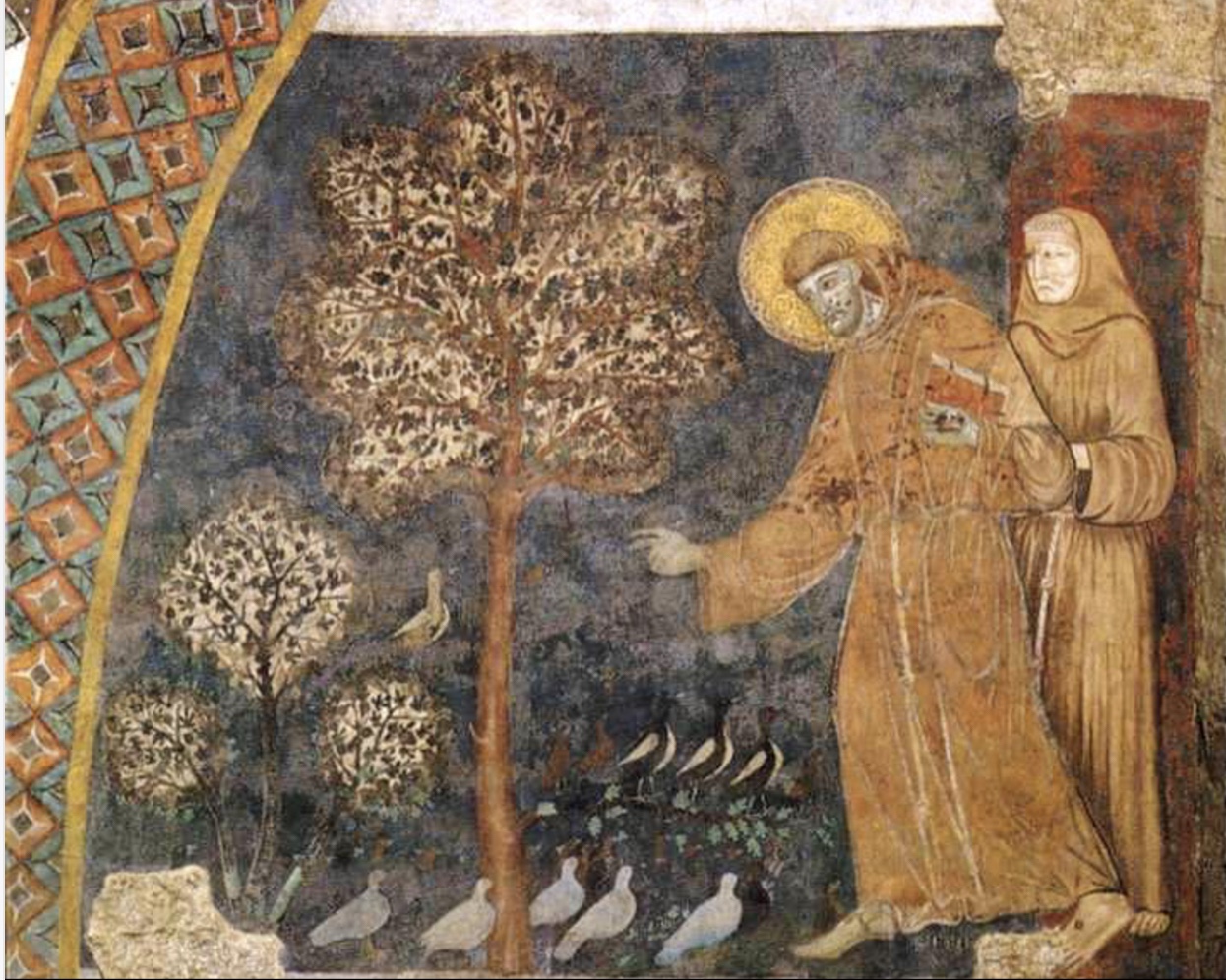
So, if I could demand something of you, it is that you give thought to the animal; that you be conscientious about your life and to see how even something as forgettable as buying a burger is a behavior that keeps in place a system that causes massive suffering to the animal as well as harm to our environment. For none of these factory farms would exist if not for their profitability, and there can only be profitability if there is demand. Peter Singer would ask you to become vegetarians, and if not, then to be mindful of the source of your food. Does the vendor you buy from source their eggs from farms where the hens don’t have the space to spread their wings? Or do they let them roam? Are these cage-free eggs? I would ask the same of you and would only add more urgency, particularly as time runs out. For I do not see a world in which humanity survives the calamity which is the consequence of its own actions but the animal doesn’t. Nor do I see a world in which both the human and the factory survive.
For us to surmount the challenge of the century, we will need to re-examine our relationship to our world and, as Derrida discovered the morning he walked into his bathroom naked, to the little furry cat that followed him, to her gaze; and thus, to what made him question his humanity and doubt what he was. And if doubt is what sets off Cartesian modernity and its progress and what sends us back to the Book of Genesis and to the birth of civilization, we will need to re-examine our relationship to the animal that one once was, to the animals, therefore, you and I and Derrida are.
Addendum (not part of original talk)
If the philosopher has neglected the animal, has forgotten it, has displaced the gaze that was (always) there, we could say that the animal has found a better friend in the literary author. And not just in authors like Jack London or poets like TS Eliot, who write of being-with animals, but in authors like Kafka who speak from the side of the animal as animal. If the Attenborough documentaries rely for their effect on our projecting ourselves into the animal (we see how the animals are like us, “the animals are us”) in Kafka that relationship is reversed (we are like the animals, “we are the animals”).
Kafka, I’d claim, shows in a particular passage a level of kindness to the animal that is quite rare even for naturalist authors. Early in the second part of “The Metamorphosis,”7 Gregor Samsa, having already turned into a beetle-like bug, “scurried under the sofa, where, despite his back being slightly squashed and being unable to raise his head, he felt immdiately cozy and only regretted that his body was too wide to fit completely underneath the sofa.” Kafka writing of the coziness of a bug shows a level of attention to the animal that is if not rare, then perhaps unique.
Now, certainly, the German word that Kafka uses to refer to the bug he becomes–Ungeziefer–is a word that carries negative connotations, one of which is “vermin,” and so you can be justified in arguing that already with this word Kafka is using a displaced animal in order to reduce his humanity. And this wouldn’t be a bad argument, except for the fact that the entire story of “The Metamorphosis” is not really about the transformation itself but about how this transformation emphasizes the fact that Gregor Samsa’s life was already dehumanized. Indeed, the story is not about returning humanity to Gregor (who dies of starvation because he sees himself as a burden to his family) but about the total indifference that this event elicits from his family.
- Derrida, Jacques. The Animal That Therefore I Am. New York, NY: Fordham University Press, 2008. ↩︎
- Singer, Peter. Animal Liberation. New York, NY: HarperCollins, 2009. ↩︎
- Adorno, Theodor and Max Horkheimer. Dialectic of Enlightenment. London: Verso, 1997. ↩︎
- Descartes, René. “À ***.” Oeuvres et lettres, 1004. Quoted in Derrida, p. 79. ↩︎
- Cf. Kolbert, Elizabeth. The Sixth Extinction. New York, NY: Picador, 2014. ↩︎
- “Livestock’s Long Shadow”, Food and Agricultural Organization of the UN, 2006 ↩︎
- Kafka, Franz. The Metamorphosis and Other Stories. New York, NY: Barnes and Nobles Classics, 2003. ↩︎
 Ruminations
Leave a comment