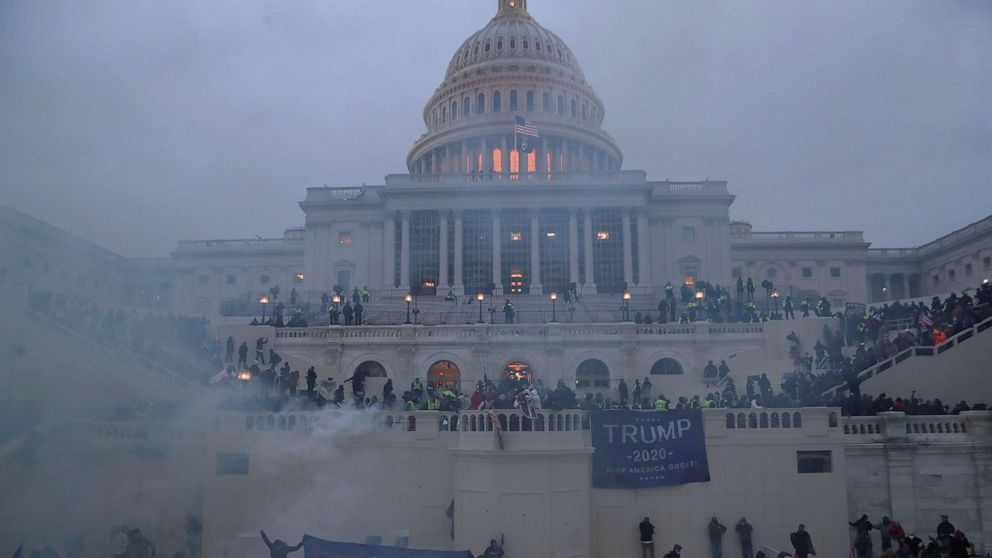
What we saw on January 6, 2021, was a shocking political sight. We saw Trump-supporting mobs break into the US Capitol. We saw the looting of Congressional paraphernalia. We saw a man proudly sit in the office of the Speaker of the House, his feet up on her desk, looking defiant. From what reporting says, he even left a note that said, “We will not back down.” Something that was clear was the visible enjoyment of the rioters. Media crews and correspondents mentioned that they gleefully came out of the capitol, certain that what they had done had been successful. There was very little, if any, remorse shown.
Some have said that the event was entirely foreseeable. A quick look at social media will show many Trump supporters wore hoodies that said “Civil War January 6 2021,” and boards on far-right platforms were full of messages that said their readers ought to prepare for action on the same day. There was, of course, a now taken-down tweet from the President.
The discussion now hinges on issues of pre-meditation. How planned was this assault? Were there people in power who aided and abetted this conduct? Were the police in on the siege? The questions can only grow more sinister.
The disheartening fact that many of these people were inflamed by disinformation and lies concerning Joe Biden’s electoral victory was not lost on the media. The media correspondents continued to say, as they reported on the ground, that the people participating in the demonstration repeated the same information that you’d find in the far-right echo chambers and which have long been publicly, even legally declared to be unfounded.
It was the quagmire that I think perfectly characterizes the Trump era: neurotic, disinformed, sinister. From beginning to end, as I watched the insurrectionists break into the building and read the reports that our elected officials had to be evacuated, I had the sensation that we were seeing the manifestation of a new American reality. Dignity and decorum, the (imaginary) concepts that guided the relationship of men like Truman and Eisenhower to the presidency and to government, even when the latter got as ugly as it did during the McCarthy years, are no longer foundational principles. Not in an America where a man steals the Speaker of the House’s lectern while George Washington looks on in the background.
Certainly, there are those who say that America has always been like this, that it is liberal white America that is beginning to face up to the fact its comforts have for a long time relied on a blindness to its own political excesses. While I agree completely with this idea—indeed, what was Jim Crow America if not an apartheid terror state for African Americans?—I nevertheless sense that there is a difference that is just now marking itself in the psyche of the nation. I think, in psychoanalytic terms, that we are living through a tremor in the national symbolic itself.
For this is what the assault on the Capitol was. Like 9/11, the siege on the Capitol was a traumatic event. It was a touch of the real. It was not as deadly in terms of the human life lost, but like that event twenty years ago, it augured the beginning of a new relation of America to itself. 9/11 showed us not only that the end of the bipolar world divided along the lines of a capitalist west and a communist east would not mean unchallenged American global supremacy, but also that America was newly vulnerable to new forms of threats that were more insidious and ideological than were their former enemies in Moscow. The siege on the Capitol showed us, with visceral inevitability, that this level of threat is also domestic and internal.
The traumatic nature of these events lay in their disturbance of the symbolic order, in the way they altered the symbols and signifiers by which we organize our cultural lives. In other words, the “world” changed. We now live in a world in which the US Capitol can be pillaged by a mob (and in which everything that happened could happen). The sanctum of American democracy has been visibly desecrated. This is no longer rhetorical.
Even those critics of American politics who say that what is being disturbed is only white, liberal, bourgeois America cannot deny these breaches in the American symbolic. For this is not a turning point, I believe, for leftist politics. There is no “opportunity,” no “chance” here, any more than there was one for the German left after Hitler’s failed putsch in 1923 nor was there one for the American left after 9/11. On the contrary, what we have to be wary of is the exploitation of the fragility of the moment for nefarious, illiberal ends. Furthermore, both 9/11 and the siege on the Capitol are products of excess, of radical contingency. They are shocking spectacles (as Baudrillard controversially said of 9/11) whose “spectacularity” in the absence of any substance, any teleology even, is what motivated them. These events were “actings out.” The siege in particular has all the signs of glee and thoughtless jouissance that characterizes a dog that finally catches the mailman’s truck. The mobs broke themselves into the US Capitol and documented themselves inside, evidently forgetting about the criminality of their action. It was as if that were precisely what they had wanted to do from the beginning (even as they harassed professional camera crews and photographers, as if to say, “We want to do the filming ourselves!”) Isn’t the internet the realm of the symbol? And isn’t their return to the internet, their vlogging and tiktoking themselves in the middle of their criminality precisely the rupture in the symbolic order?
In Beyond the Pleasure Principle,1 Freud wrote that he was surprised to find that his patients, such as traumatized soldiers returning from World War I, were not so much remembering their traumatic histories as repeatedly reliving them, acting them out, via neurotic behaviors or nightmares. This was a problem for Freud, who wrote in his Interpretation that dreams were “wish fulfillments.” How could a nightmare that repeats a trauma fulfill any wish? Freud explained this by resorting to the concept of the death drive, a concept originally invoked by Sabina Spielrein.
First, Freud believed that the biological organism is conservative and restorative by nature, meaning that it has little tendency to change if there is no outside stimulus forcing it to change. Thus, he speculated that a drive (or instinct in the Standard Edition) is an “urge inherent in organic life to restore an earlier state of things” (43). This would mean, for him, the inorganic void, to the age before organic life. Freud, therefore, concludes, “The aim of all life is death” (46), non-being. An instinct, however, ought to preserve the life of the organism or lead to its proliferation and this paradox was not lost on Freud. “The hypothesis of self-preservative instincts . . . stands in marked opposition to the idea that instinctual life serves to bring about death” (46). And so, in a rather bewildering move, Freud posited that these instincts have one function: to “assure that the organism shall follow its own path to death and to ward off any possible ways of returning to inorganic existence other than those which are immanent to the organism itself” (47). An organism lives in accordance with (life) instincts that help it to continue its life as it faces external pressures and threats, and (death) instincts that allow it to “die only in its own fashion.” These latter “instincts” or drives are what make possible a patient’s self-destructive neuroses and compulsions. Freud saw in the concept of the death drive the structure with which to explain at once why people often unconsciously repeat what is painful and why they engage in seemingly self-destructive behavior at all.
I see the siege as something to which the concept of the death drive can apply. I see the Confederate flag being carried through the halls of Congress and I see, in a symbolic and imaginary sense, the return of the old conflict that tore the country apart in 1861. It is the “return of the repressed.” And isn’t it not only the return of the conflict per se, but of its failure as well? For as we now know, the Congress returned to their task once the glass shards had been swept and the plaster dust cleared. Joe Biden’s election was certified. The siege succeeded only in the inconvenience of a delay. And in fact, it convinced some Republican senators to retract their objections to certification. The mobs filmed themselves in their criminal glee and they left ample evidence for their arrest, an act, almost, of self-sabotage.
The event was traumatic. I’m sure that much ink will be spilled trying to understand it. But what is clear to me is that it is evidence of the beginning of an era of suspicion. Contrary to what David Foster Wallace thought would occur after the postmodern malaise—a “New Sincerity”—what we are heading into is an age in which what we will feel when we look at a fellow American is doubt and insecurity. It seems as if we have only deepened the malaise. Knowing full well that there is a contingent of Americans who derive their truth and political will from a disinformed media ecology, how can we ever be certain that the Other into whose eyes we look sees us with any understanding, let alone acceptance?
And indeed, even if we acknowledge the fact that what happened on January 6th is not as “un-American” as some politicians would hope, this problem is nevertheless a pressing one. As Freud discovered, the problem is not the history of the patient, but rather its painful repetition. The shock of the rise of Augustus and the end of the Roman Republic was not any the less just because Caesarism was already part of Roman history.
- Freud, Sigmund. Beyond the Pleasure Principle. Translated by James Strachey. New York: W. W. Norton & Company, 1961. ↩︎
 Ruminations
Leave a comment