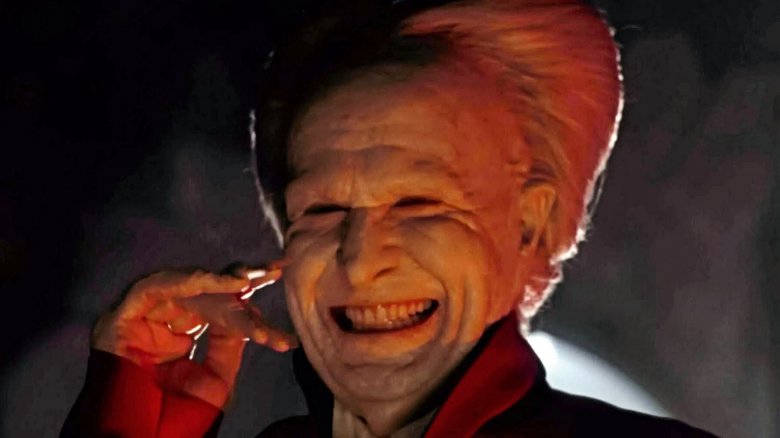
(Talk given on April 1st, 2021, at Miami-Dade College, West Campus; part of the Literary Fest program produced by the Literature Club)
The question that I want to pose today is “What Does the Monster Want?” It’s a question that I’m borrowing from a far more famous or perhaps infamous question that was posed by Sigmund Freud to his fellow psychoanalyst Marie Bonaparte: Was will das Weib? What does woman want?1
Freud’s question represents how stumped he had become on the issue of what Jacques Lacan would later call “feminine jouissance,” or feminine enjoyment. What was it that women wanted? What are the linkages between gender and desire? Is one justified in believing that Woman’s relationship to desire is like that of Man? Not only are the questions intractable as far as they deal with gender and sexuality, but they also strike at the core of psychoanalysis as both a therapeutic enterprise and theoretical field. Freud’s theories, for example, relied on the priority of the male subject.2 The Oedipus complex—which is the concept invented by Freud in which the child falls in love with the opposite-sex parent—is easier to understand if one takes the child who goes through the complex as being a heterosexual male: the (heterosexual) boy falls in love with the mother and feels jealous resentment towards the father, which in turn “castrates” him. But what of the girl? Does she fall in love with the mother first and then the father and thus suffers two frustrations?3
Now, I wanted to bring that discussion to the monster, to the villainous figure as it appears in “The Strange Case of Dr. Jekyll and Mr. Hyde,”4 Frankenstein,5 and Dracula.6 Why? Because it shouldn’t take long for a reader to recognize even at an elementary level that an important characteristic of the monster is precisely their being in a state of heightened desire, of what you might rightly consider a state of extreme lack. They are, as the philosopher Gilles Deleuze would probably delight in calling them, “desiring-machines.”
It is for this reason that I turn to psychoanalysis, for this is the only theory out there that to my awareness takes desire as the primary focus of its investigations. If you have taken prior classes in psychology, you may have heard of psychoanalysis as the therapeutic endeavor that emphasizes the recovery of the patient by bringing to consciousness what is in the unconscious. Many of you likely see it as one theory among many, a chapter in a psychology textbook situated somewhere between the origins of modern psychology and developmental psychology. And many others perhaps will already express the skepticism with which psychoanalytic theories have been treated in the anglo-phonic world. Indeed, notice how difficult it’d be to argue that something like the unconscious exists if it is by its nature unconscious, if it cannot be precisely measured or evidenced. If you follow strictly the theories of Immanuel Kant, the paragon of Enlightenment philosophy, you’d say the unconscious is not real. That’s why everything that can be said of the unconscious has come as a result of our paying attention to the many ways in which conscious action leaves behind residues, or traces: slips of the tongue, dreams, systemic discoveries. (If you’ve ever heard of the term systemic racism—that is, the racism which is not ideologically self-conscious, but which reappears as a general phenomenon, often in the form of statistics—there you will have “evidence” of the unconscious.)
As Freud theorized in works like Beyond the Pleasure Principle and The Ego and the Id, the unconscious is the storehouse of repressed libidinal urges and wishes and is a constant pressure on the ego (or consciousness in general). The unconscious as id is concerned with satisfying itself and thus follows “the pleasure principle,” while the ego, on the other hand, is the psychic skin which we present to the world and which thus modulates our existence with waking reality. It follows, therefore, “the reality principle.” Much of our waking life is spent in denying unconscious urges and wants access to our consciousness. And so, unlike much of the philosophical tradition since Descartes, Freud’s theories belong to those disciplines that do not see the human subject as “whole,” as “unitary.” As Dr. Jekyll in Stevenson’s story confesses, “I knew well that I risked death; for any drug that so potently controlled and shook the fortress of my identity, might . . . utterly blot out that immaterial tabernacle which I looked to it to change” (69). The very fact that there exists an unconscious, a side of ourselves that runs ahead of us, that is authentically us, means that our very subjectivity is split, unstable and that it surely cannot be the foundation for any closed system of knowledge of the self. Indeed, as Carl Jung wrote, we have an “Undiscovered Self.”
The unconscious, then, becomes, for Freud, the source of much disturbance. The struggle between the unconscious and the ego, the latter of which is there to regulate the unconscious, becomes the terrain for the development of neuroses. We begin to desire because we lack. We seek what we don’t have. And because of our primordial struggle in the Oedipus complex, we learn that frustration is a constitutional part of life. We are thrown into the world to desire, to want things, to constantly define ourselves. Even if we were to follow an eastern discipline, such as Buddhism, which teaches us to vanquish our desires because they inevitably lead to suffering, we would still be in the cycle of desire: you would desire to desire nothing. Again, in the Buddhist symbolic economy, what solves the conundrum of the void of being, of the state of lack, is precisely the quest towards asceticism, a negative desire. The answer to the void is to let everything become void.
All of what has been said is important in our discussion of monsters because we have to recognize that in the three great classic horrors—and I’d even venture to say in every horror thereafter—runaway desire is precisely the component that makes the monster monstrous. It is the way the monster relates to jouissance and their capacity to come close to achieving it that terrify us. Furthermore, if we read these stories carefully, we can even detect that the true horror in them is how the desires expressed by the three villains—Hyde, the Frankenstein monster, and Dracula—represent or embody the very desires of the main characters themselves. The horror that the characters and we as readers experience is precisely the horror of looking inside: the monster is latent desire manifested, made concrete. Certainly, this is most obviously the case with Jekyll and Hyde, but you can also say the same of Frankenstein’s monster and Dracula. For example, when Frankenstein’s monster asks Victor for a mate so that he wouldn’t have to be alone for the rest of his life, are we really so blind as to think that this is not what Victor Frankenstein would want most himself? Didn’t he say his curiosity was wholly pointed towards the study of the principle of life? He has already animated a life which is that of the monster. And here he is given the chance, in the form of a demand, for him to play God and build his monster’s Eve. For only then, only when he has given his creation the opportunity to procreate can he say that he created life. People often forget this. Life is not one being. Victor did not create life by animating one being. But when the monster begs him to develop for him a mate, there is the opportunity. Naturally, seeing as how Victor says no to this under his rather tiresome moralizations, Victor begins there to act like an obsessional neurotic. He represses his desire. And, as Freud said in a little short text called On Dreams, “repression . . . the formation of compromise, this is the fundamental pattern for the generation not only of dreams but of many other psychopathological structures.”7 And Jekyll himself says something to this effect when he says, “I concealed my pleasures; and that when I reached years of reflection, and began to look round me and take stock of my progress and position in the world, I stood already committed to a profound duplicity in life” (67).
To summarize, we have to keep in mind, first, that monstrous desire is excessive. Dracula doesn’t have just one bride; he has three very, very beautiful vampire ladies; and he tried to conquer two more, both of whom had already been engaged if not married to other men. And secondly, these excessive desires are precisely those of the main characters themselves. For, is it any surprise that Dracula’s women attack Jonathan Harker only a little before he is to be married to his beloved Mina? Or is it any surprise that it would be Jonathan himself who would behead Dracula with his kukri knife, a phallic item if there ever was one?
So, desire. What is desire, then? Notice how we have taken desire to be simply the state of want, a wanting of something, but how does it differ from need, for example?
Here, the theorist that will help us is Jacques Lacan, the most important psychoanalyst since Freud. In his 1958 écrit, “The Signification of the Phallus,” Lacan wrote that “desire is neither the appetite for satisfaction nor the demand for love, but the difference that results from the subtraction of the first from the second.”8 In other words, desire is what remains when one takes away need from any demand for love—which can take the form of a simple regular demand such as one for nourishment.
For Lacan, a baby is born with needs. The baby will communicate those needs to its parents using what means it can: crying, cooing, and so on. But as the child grows it will fall into language and for its needs to be met the child will have to parse the requests for the satisfaction of his needs through language. The child must learn how to speak, how to ask nicely. In time, the child learns that the meeting of its needs, as they become demands in language, begin to be supplemented and enriched precisely because of language. A child learns, for example, that if she learns to ask for milk politely, she will be rewarded with the milk and her mother’s smile. As a result, the demand, precisely as it is that in which the need has been invested becomes more than the need. It becomes, as Lacan pointed out earlier, a demand for love, a demand for a place in the symbolic order. Desire is precisely this supplementation, this search for the mother’s smile, which can only be a product of the child acquiescing to society’s symbolic structures and linguistic requisites. Desire is when you’re hungry—so you have a need—but it is the sushi that you pick over the burger. Again, to paraphrase Lacan, desire is need subtracted from demand.
This pseudo-mathematical formula has two radical consequences, which are what will structure the rest of my talk today. If as Lacan writes, desire is this taking away of need from demand so that desire is this pure surplus; and if it is the entry into language which directly creates this surplus, then our desire has an intrinsic relation to the symbolic order, to the world of language and culture because again it was precisely the world of etiquette and family and church that taught us how to articulate our needs while making them smile. You don’t even have to look very far to find evidence of this. Just look at any profile in Tinder or Grindr or whatever you use and tell me how many people explicitly say that what they have is a need. No, on the contrary, what they express are purely supplementary elements: muscles, cars, luxury items if they have them, activity interests, and so on. There is even today a certain etiquette to the use of emojis. The symbolic order which Lacan chooses at times to call the Other with a big O is what tells us what and how to desire because it is what gives us the language in which to do so. We cannot desire outside of language any more than a train can reach its destination by going off the rails. As Lacan said in his First Seminar, “man’s desire is the desire of the other.”9
In Frankenstein, this is saliently the case. When the monster relates his experience to Victor at the top of an icy mountain, what he complains about is the fact that the enjoyment is foreclosed to him. “Everywhere I see bliss from which I alone am excluded” (128). The monster cannot tolerate the happiness that he sees the other enjoy and of which he thinks himself deprived. In a way, you can think of the monster as developing a “revolutionary” subjectivity, for is this not the very same implicit argumentation at work in popular political discourses? “The wealthy are doing too well. The poor are doing very poorly. It is intolerable to see a billionaire having 10 yachts while a middle-class family goes bankrupt because their child got sick.” I, of course, am seeking to make a political point at the moment but only to emphasize the human universality of the monster’s angst.
As Slavoj Žižek has argued, hysteria occurs when “the subject cannot ever fully and immediately identify with his or her symbolic mask or title.”10 For example, my current symbolic mask is that of college professor. I would be a hysteric if for one reason or another I were incapable of identifying as one. In the monster’s case, the monster decries his lack of access to the symbolic, to the realm of meaning; he decries the fact that as he stands, he is a signifier for everything that does not belong to the human. “What was I?” the monster asks himself (169) and notice how he ultimately gets his answer by reading Victor’s notes, perhaps not unlike the way many societies derive their ideological or historical identity by reading from the texts that delineate their origins. Indeed, nothing is more emblematic of the symbolic order, of the Name-of-the-Father, than the very blueprints Victor wrote that detail how he built the monster. In some sense, the monster is in the rather enviable position that he actually can question his maker whereas we poor regular humans are condemned to complain into the void.
The particular position of the monster as outside the symbolic, as being that which cannot be welcomed into the human community can also be interpreted from a Lacanian angle. In the 1960s, Lacan would theorize that the unconscious is structured like a language: “it is the whole structure of language that psychoanalytic experience discovers in the unconscious.”11 This would require some explanation at length, so for the moment all you need to know is that what this means is that our unconscious is not in us as Freud would have believed, but rather outside us, determining us in the same way language determines us. The unconscious isn’t a language but is structured along the lines of one. Lacan recalled that Freud mentioned that dreams, offshoots of the unconscious, seemed to work in ways similar to those of a rebus puzzle. Lacan figured that there must be a logic to the unconscious, and if such a thing was possible, then the unconscious must be symbolic in nature. (I could perhaps answer your questions regarding this if we have time at the end.)
Therefore, the pleasure principle, which is the concept that says that our unconscious always seeks its own satisfaction, was itself some function of the symbolic. Furthermore, Freud wrote that just as we have a pleasure principle, or life drives, we also have death drives. Freud theorized about these latter drives to explain the self-destructive behaviors that people often seemed to engage in, or to explain why, for example, soldiers returning from war kept on having war nightmares. Lacan takes this concept of the death drive, which is beyond the pleasure principle, to postulate that there is a beyond to the symbolic order, and that this death drive is inimically connected to jouissance. (Think here of all the pleasures we love that are very, very bad for us!) This beyond is the traumatic core, the real kernel. If the symbolic is not just what makes us understand the world and what perhaps is the world, but also what houses our unconscious, then that which presupposes the symbolic itself and lies beyond it at its center like the black hole spinning at the heart of our galaxy is the real, what Freud called the Thing. Das Ding. This is impossible enjoyment, the indescribable. What cannot be spoken. As Žižek writes, “the term Thing is to be taken here with all the connotations it possesses in the domain of horror science fiction: the ‘alien’ from the film of the same name is a pre-symbolic maternal Thing par excellence.”12 The real in Lacanian theory is precisely what cannot be symbolized, what our discourses have no way of understanding. The real is the answer to questions such as “Does your life have meaning?” “Is there an end to class struggle?” “Is the sexual relation possible?” (This last question is just the Lacanian version of the question, “Will I ever be happy?”)
Anyhow, to go back to our monsters, I would argue that Frankenstein’s monster is this figure; he is this traumatic core, this real kernel which the symbolic cannot allow to enter, though, in the very fact that he’s there, he provides Victor with the dialectical opportunity to define precisely what it means to be human. And what is being human? Well, Victor will say, it’s not that Thing. The human is whatever the monster is not. The monster will not be allowed to enter into the symbolic and yet by the very abyss he opens up he is ultimately what allows the question of humanity to be raised. Indeed, this is Mary Shelley’s master stroke: the very presence of the monster—and by the way notice how he’s not named—we tend to forget how inhuman and robotic, how utterly bland and puppet-like the other characters are.
Meanwhile, like many real humans the monster is a complete neurotic. In his lonely sojourns, as he endures people’s fear and their thanklessness, we find that he has no capacity to see himself as the Other sees him: as precisely that monstrous being. Instead, especially in the episode where he saves the drowning child which culminates with him getting shot, he gets angry that the Other doesn’t see him the way he sees himself! As a savior!
When the monster says, “All joy was but a mockery, which insulted my desolate state, and made me feel more painfully that I was not made for the enjoyment of pleasure” (187), how can we not feel the depth of his angst, of the very human envy which rises from the fact that all he does is see the desire of the other that—as far as he knows—will never be his. “[M]y vices are the children of a forced solitude that I abhor; and my virtues will necessarily arise when I live in communion with an equal,” the monster suggests (195). The monster is now a hysteric. If Freud had been sitting there in front of him, he would have asked him if he hadn’t ever considered the fact that the one with the problem was not the world, but the monster himself; that though his ugliness is acute and the ostracism he encounters in the world is quite pervasive, those are no reasons to go out and murder. The monster, it seems to me, never had the chance to enter and see a house filled with lepers; nor did he seem to think that his woe was not singularly his.
The second consequence of the fact that a demand is an over-writing of need via the socio-symbolic supplements inherent in language, is that to quote Lacan again, “Desire for recognition dominates the desire that is to be recognized, preserving it as such until it is recognized.”13 Lacan says that we desire to have what we desire recognized, our desire for something is “dominated” by our desire to have that desire validated.
The evidence that Lacan gave came from his very patients, who continued to insist on their desires. Whatever repressed desire it was that brought them to sit it in front of Lacan kept on reappearing in their discourse; so that it would begin to seem like they themselves were the ones who, first, didn’t want to lose their desire and, second, wanted Lacan to recognize what it was they desired. As he says as usual in awfully cryptic terms, “What the neurotic does not want, and what he strenuously refuses to do until the end of his analysis, is to sacrifice his castration to the Other’s jouissance, by allowing it to serve the Other.”14 Perhaps what we have to come to terms with is the fact that we often want the other, whoever that is, to acknowledge the fact that we want what we want. We do not want to resign ourselves to a life of no desire (this is the “castration” mentioned above) in light of the enjoyment of the Other, of enjoyment of the world outside us and all its concomitant symbolic manifestations.
This brings us to the issue of recognition. Psychoanalysis has long understood perhaps with Aristotle, that sight is very, very important, since the gaze is recognition; the gaze is power. Freud developed a concept called in German Schautrieb or Schaulust, meaning the “drive to look.” As Freud writes, “the optical impressions remain the path along which libidinal arousal is most frequently awoken.”15 Our desire to look at things is the sublimation of our desire to see the body uncovered for the sake of the maintenance of our sexual curiosity. Later, Lacan would see the gaze, particularly as it is reflected in mirrors (physical or other), as constitutive of the ego and of what he would call the imaginary register.
Let us re-call here how this notion of recognition, which as we said is the second aspect of desire that we want to explore, is inscribed in the word monster, which comes from the Latin monstrum, meaning a warning sign, an alert, an omen of misfortune. It is a word that etymologically and literally refers to a signifier, as some thing that has no other purpose but to be recognized.
Now, if the gaze is what allows for either recognition or what constitutes what an other is for us, then what do we say of Mr. Hyde, Frankenstein’s monster, and Dracula? How are they described?
Notice how Mr. Enfield describes Mr. Hyde: “He is not easy to describe. There is something wrong with his appearance; something displeasing, something down-right detestable. I never saw a man I so disliked and yet I scarce know why” (11). Later on, the narrator continues: “only on one point were they agreed; and that was the haunting sense of unexpressed deformity with which the fugitive impressed his beholders” (31). Notice how unclear and ambiguous this is. Enfield dislikes Hyde but doesn’t know why; and the narrator confirms Hyde’s deformity as “unexpressed.” He does not look deformed.
On the contrary, descriptions of Frankenstein and Dracula are clearer. Of Frankenstein, Shelley tells us, “his yellow skin scarcely covered the work of muscles and arteries beneath; his hair was a lustrous black, flowing; his teeth of a pearly whiteness, these luxuriances only formed a more horrid contrast with his watery eyes, that seemed almost of the same color as the dun white sockets in which they were set, his shriveled complexion and straight black lips” (66). And Dracula also is described at greater length: a “strong” face, “aquiline” nose, “arched nostrils,” “lofty domed forehead,” “massive” eyebrows, “bushy hair,” peculiarly sharp white teeth” which protruded over the very red lips. (29)
Now, Freud wrote that this desire to look, this drive to look, this Schautrieb, was a product of our childhood development. We see Frankenstein’s monster living in a little hovel spying on his cottagers through a little chink in the wall and when he sees the girl Agatha and her father together, he says, “I felt sensations of a peculiar and very powerful nature: they were a mixture of pain and pleasure such as I had never before experienced, either from hunger of cold, warmth or food” (140-141). Is this not precisely voyeurism? Is it not scopophilia, the pleasure perhaps sexual that one derives from looking? Freud argued that the root of this pleasure is found in our childhood curiosity regarding the sexual organs of other people. In his “Three Essays on Sexual Theory,” he wrote that the “sexuality of neurotics has remained in an infantile state.”16 Freud goes on to argue that this question regarding the sexual stems from the child’s anxiety in seeing that as soon as a sibling is born, the attention from his parents that was always solely bestowed on him would now have to be shared. In other words, the desire to inquire into the mystery of how it could be possible that another little creature could be born to cause him such anxiety becomes the desire to know about sexuality and to know if everyone is organically like him.17
Isn’t this in some sense what the Frankenstein monster does? Isn’t he in an infantile neurotic state asking the questions that a child asks, wondering how it could be possible that the family of the cottagers he’s stalking could enjoy the pleasures of what we culturally call love? For all intents and purposes, the Frankenstein monster is a baby! To say that the monster is a grown man or utterly capable of moral action in the same way that an adult is capable of would be to forget a fundamental truth of the human which is that to be an adult, to grow, means precisely to be smashed against the brutality of the biology of our changing bodies (meaning going through puberty, menopause, and so on—the fact that we are not actually in control of our biological rhythms) and to realize that frustration is a part of natural and social life. The very fact that the entire novel is essentially about how the monster torments Victor, his father, makes very obvious the Oedipal dimension at work.
Notice, furthermore, how the same applies in Dracula and in “Jekyll and Hyde.” Towards the end of Dracula, Van Helsing explains that though Dracula is very cunning and ancient, “In some faculties of mind he has been and is, only a child” (413). Similarly, Dr. Jekyll notes that Hyde was “so much smaller, slighter and younger than Henry Jekyll” (71). All three monsters could therefore, be considered cases of arrested development, “perverse” creatures in the Freudian sense. A part of what makes them eerie is the same horror that we see in the radical innocence of children. All the lurking and stalking and watching: what can it be if not the lurking and stalking of a child around the house wondering perhaps what their parents are up to at night. Again, to close this section, what is Frankenstein’s story if not precisely a cautionary tale warning us of the danger of excessive desire for knowledge, of excessive curiosity! “My temper was sometimes violent, and my passions vehement; but by some law in my temperament they were turned not towards childish pursuits, but to an eager desire to learn” (38). Victor Frankenstein even goes as far as blaming this excessive desire as being the cause of the great evils of slavery, colonial conquest, and tyrannical rule (65).
Now we said before that while Frankenstein’s monster and Dracula are described relatively well, Hyde isn’t. Edward Hyde is indescribable. “There was something abnormal in the very essence of the creature that now faced me,” writes Dr. Lanyon. And yet despite the fact that the characters don’t know what it is about Hyde that they dislike, they know they dislike him. This leads us to our next topic: the monster as disturbance and sexual threat.
In a general sense, all three monsters are reviled by the protagonists. They are, after all, dangerous and deadly creatures. All three of them kill. But we should question, what is the nature of this disgust? Why is it that on the one hand the protagonists reject him totally, though the monsters are so inimically tied to their desires: Frankenstein’s monster is a product, literally, of Victor’s desire for knowledge; Hyde is product of Jekyll’s desire for moral purity; and Dracula represents for Jonathan Harker precisely extra-conjugal jouissance. In other words, the more-than-pleasure of extra marital affairs. (Notice how utterly devoted the novel is in pairing people up and having the women be shared by the men!)
What the Hyde case reveals is that the animosity the protagonists feel towards the villains has neurotic sources. Do not be trapped in the pseudo-mystical language that all these Victorian or proto-Victorian authors love to roll in the mud with. There is no such thing as auras or radiances or anything coming out of Edward Hyde. And, no the Frankenstein monster is not a “daemon.” The source of anger at Hyde is precisely neurotic. This is the response a patient gives when they enter into transference in a psychoanalysis. This is when they get defensive, when they project, when they see that the analyst is getting real close to something very deep and sensitive. In Dracula, Jonathan Harker has a similar experience when he meets the Count. “It may have been that his breath was rank, but a horrible feeling of nausea came over me, which, do what I could, I could not conceal” (30). I don’t know about you but when someone’s breath is bad, we know that it is or it isn’t. There is no wishy-washiness there. So again, what we have our characters having unconscious reactions. They cannot explain them; their reactions are like the symptom which is a malady whose source is unknown to us. Something has been repressed and is now returning.
Freud believed that all neuroses had at heart sexual origin, that it was because we had repressed an unsatisfied sexual urge that the urge would begin showing up as a neurotic formation. In “Jekyll and Hyde,” it’s anger. In Dracula it’s nausea.
Indeed, it’s not long after Jonathan Harker enters Castle Dracula that he encounters Dracula’s three companion ladies. And what does he say? “I felt in my heart a wicked, burning desire that they would kiss me with those red lips” (56). And remember that he is in the forbidden room which the count had forbidden him to enter, admitting he “took pleasure in disobeying [the count’s] order” (55).
Dracula as disturbance is interesting for another reason. This has to do with the peculiar but extremely fascinating term Stoker uses to refer to him: “the undead.” This word describes the vampire’s existential condition. The vampire is a creature that is for all accounts not alive in the full human sense. But which nevertheless goes on. One can perhaps consider it a limbo, a state of in-betweenness—what the vampire most represents is epistemological uncertainty. Van Helsing and the rest must vanquish the vampiric Lucy so that she could finally die, so that she can stop being this physical reminder of the existence of contradiction, of the abyss that is subjectivity—human or vampiric. As Van Helsing says, he “has a duty to the dead” (282).
Related to this notion of disturbance is the idea that part of what makes the monster horrifying is its capacity for sexual violence. In other words, the monster is a sexual threat. This comment is, I think, extremely obvious.
When the Frankenstein monster finds Justine asleep in a barn, he whispers to her: “awake, fairest, thy lover is near—he who would give his life but to obtain one look of affection from thine eyes: my beloved, awake!” Here it is entirely clear what the Frankenstein monster wants, though he is at this point so hysterical that it’s not long until he begins to obsess over whether Justine will hate him or love him. In other words, he begins to obsess over the Other’s desire. The possibility of assault, coupled with the monster’s words make this one of the most sinister passages in the novel.
Later on, what is it that the monster says when he threatens Victor? “I shall be with you on your wedding night” (225). And what is Victor’s response: “I thought of Elizabeth, of my father, and of Clerval; all left behind, on whom the monster might satisfy his passions” (231). This begs the question: what passions is the monster seeking to satisfy? Certainly murder, but is that the only one? In Frankenstein the monster is as innocent and childish as he seems to be sexually threatening. This was the same fantastical structure the great thinker and psychiatrist Franz Fanon recognized in the post-colonial racist description of the black Caribbean male: colonial Blacks were at once backward and innocent and childish, but also sexually potent and a danger to the otherwise vulnerable white female.
In Dracula, you can tell that one of the effects of vampiric transformation is a strange sexualization. Notice how Dr. Seward describes Lucy when the men see her in her vampiric form: “the sweetness was turned to adamantine, heartless cruelty, and the purity to voluptuous wantonness” (287). Here voluptuous connotes excess, and wantonness caprice, precisely traits which in this case are used as signifiers of sexual immorality.
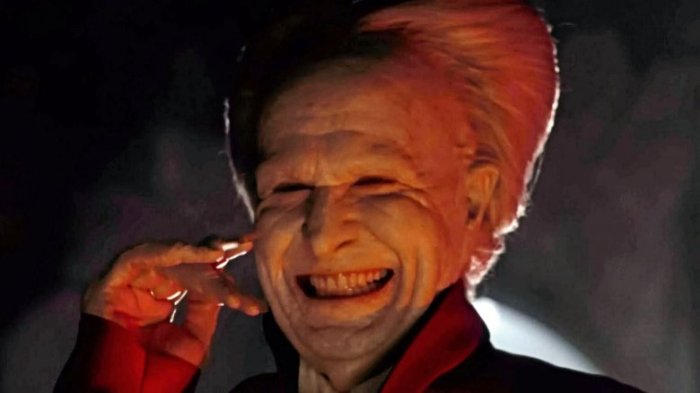
We mentioned before that according to Jacques Lacan, desire is the desire of the other. We want what the other wants. And so, to see the other enjoying can elicit aggressive tendencies in us when we discover that we are somehow barred from the same enjoyment. As we mentioned earlier this was neurotically the case with Frankenstein’s monster who hated to see the enjoyment of humans, but this also works backwards. In all three stories, we do see some level of enjoyment occurring in the monster. How do we know this? Because they smile a lot. In Dracula, vampiric Lucy’s face “became wreathed with a voluptuous smile” (288). And we recall that at the end of the novel, Dracula’s lady trio love to cackle. Frankenstein’s monster similarly cackles and laughs at Victor’s misery. The Slovenian psychoanalytic philosopher Alenka Zupančič has spoken about the fact that one’s enjoyment, as in the enjoyment of a joke, comes always at the other’s expense.18 I am not sure about the degree to which I concur with that myself but I find it nevertheless a powerful idea.
The only possible exception to all of this is possibly Mr. Hyde, who for all intents and purposes seems awfully desexualized. The only point of contact that he makes with someone of the opposite sex—and we are here assuming, as Stevenson and Stoker and Shelley would have assumed, that heterosexuality is the normative sexual structure—was at the beginning when Enfield recollects that he saw Hyde trampling over a little girl. As Jenny Davidson has written, “the narrative does not accuse him of the more obvious offense that a man might inflict on an eight- or ten-year old girl in a London slum.”19 She then observes that “Stevenson seems to have gone to some trouble to exclude sex from his story.” She argues this might have been because of Stevenson’s somewhat polemical desire to decouple sex and sin in the face of respectable society’s determination to make the two synonymous.”20 And as we mentioned, Mr. Hyde’s physical form doesn’t seem to be very appealing or interesting for that matter. I leave it to you to wonder what the effect is of this censored story. Is Stevenson successful? Has he totally siphoned off all sexuality from his tale? Has he been repressed it? And if he has repressed it and if you begin to think like a psychoanalyst, does sexuality then return in another guise, in the form of a neurosis embedded at the level of the text?
We have woven a somewhat dense tapestry of desire between the villain and the other. We have discussed the nature of desire and how desire is what remains when the demand cuts away from the need, how the entry into language creates this gap which is desire. We have discussed how desire is both the desire of the other as well as the desire for recognition; and how the desire for recognition is deeply related to our ego and to the way in which we can generate pleasures simply by watching and observing. And last, we have discussed how the monster exists as a disturbance and possible sexual threat. All of this leads to the final claim I’ll make which in some senses unites many lines of thought already traced, and that is that the monster is at heart the very double of the protagonist, the monster is his or her semblant. They are the materializations of precisely the protagonist’s unconscious desires. And it is for this reason, for the fact that these monsters represent that which they desire most—in other words, for the reason that these monsters are the real kernel at the heart of the protagonists’ symbolics—that the protagonists despise them. Freud always said that a patient gets defensive when the analysis begins to skirt close to the real, to the traumatic core, to truth. And I claim the same occurs here. As Žižek implied, the monsters represent precisely this threat to the symbolic, they represent the impossible enjoyment which is utterly untouchable by language and culture and which put into danger the entire symbolic structure.
As I mentioned already, what does Frankenstein want more if not to fulfill the monster’s demands? What is life if not, to use Hegel, the very process of creation? In the monster, Victor has created an oddity, not life. And by the way, a life is not life, any more than a human is humanity. But if that same oddity were to have children, Victor would ascend to the rank of the titans.
Similarly, would Jonathan Harker or John Seward or Quincey Morris or Van Helsing ever say that what they want is precisely to live the count’s life: an eternity of orgiastic pleasure with equally immortal beautiful women? Or, if you are an even more careful reader, an eternity of homosexual enjoyment?
Have we forgotten how Count Dracula declares Jonathan “his” as soon as he saves him from his three ladies? Or how Lucy Westenra requires so many blood transfusions that by the end of the novel the blood of four men is flowing in her body? Let us not assume that Bram Stoker is not aware of one of the most famous poems in English literature: John Donne’s “The Flea,” the first of whose stanzas I’ve put here:
Mark but this flea, and mark in this,
How little that which thou deniest me is;
It sucked me first, and now sucks thee,
And in this flea our two bloods mingled be;
Thou know’st that this cannot be said
A sin, nor shame, nor loss of maidenhead,
Yet this enjoys before it woo,
And pampered swells with one blood made of two,
And this, alas, is more than we would do.
The flea bites and sucks the blood of the lover first and then that of the beloved, so that “In this flea our two bloods mingled be.” The speaker then says that this little fact is no sin, no shame, no “loss of maidenhead,” or virginity. The flea carrying the blood of the lover and the beloved comes to represent the very act of sexual consummation. The speaker wants to have sex with his beloved and tries to reason her out of her reticence; which is why he says at the very beginning: “How little that which thou deniest me is.” She is denying him the sexual act and he says essentially that in the flea the sexual act is already happening. Taking this literary conceit into Dracula, it’s difficult not to think of Lucy’s blood transfusions as a metaphorical opportunity for transgressive, homosexual commingling.
Indeed, after Lucy “dies” and she has been buried, Arthur says, referencing the blood transfusion thinking he was the only man who had donated his blood to her, “he felt since then as if they too had been really married, and that she was his wife in the sight of God” (239). The novel, in this moment of pure irony, does not want us to forget one minute of the fact that three other men had put their blood into Lucy without the awareness of her fiancé.
As for “Jekyll and Hyde” it is all too obvious that Mr. Hyde is Jekyll; he is every bit his double. Mr. Hyde is simply Jekyll’s displaced libido taken on human form and made free to roam. Jekyll has expelled his desires. “I stood already committed to duplicity in life,” Jekyll says (67). He shows himself committed to a double life. He even philosophizes about it: “man is not truly one but truly two” (68) [which, by the way is also incorrect!].
The themes in the story are those of alienation. Can I alienate myself—alienate my passions and my lusts—completely and put them into another? Jekyll hypothesizes not only that he can but that in so doing he will be free or happy or fulfilled. Jekyll declares Mr. Hyde evil and he is indeed not a “good” creature, but the word clouds the clarity of what happens to Mr. Hyde. Jekyll’s mistake was ultimately one of misrecognition, of the fact that he thought himself to have been good prior to his transformation and that all he required was the excision of the evil one. But as he himself comes to know, the separation of Hyde from Jekyll does not produce the mythical good/evil dyad, but rather something far more perverse. There is the “evil” of Hyde on one side, and then the divided, conflicted mixture of good and evil on the other. As Jekyll himself puts it: “one was wholly evil, and the other was still the old Henry Jekyll, that incongruous compound of whose reformation and improvement I had already learned to despair” (72). To argue that Henry Jekyll was good is to fall into his own error, which was, first, to declare that one’s desires are evil, which we can trace perhaps to Stevenson’s own Presbyterian-Calvinist Christian psychology; and second, that desires can be successfully excised from oneself without radical cost. There is very little that tells us what you are more than what you desire. As psychoanalysis as long understood, what you believe yourself to be—your imaginary constructs and how they work within the symbolic order—is often awfully unreliable in determining this essence of yours. But there is something about desire and jouissance, about enjoyment, that is quite authentic, that seems to sprout from the very kernels of your being.
We know Jekyll does not experience this enjoyment in scholarly life, whereas Hyde is pure jouissance. Indeed, despite the horrors of what Hyde considers enjoyments—trampling on a child, caning an old man to death—notice that there is bliss in his actions. They are certainly irrational but there is a vitalism to Hyde which is precisely what threatens Jekyll’s life.
The death of the monster does not come without a price. The victory is pyrrhic. For if what the destruction of the monster means is the extinction of that part of the psyche which is also us, which is part of our very constitution, then by the end of these stories, the characters have lost if not their lives, then a crucial aspect of their being. If anything, what I hope you take from this lecture is the awareness of the fact that our reactions to the monstrous tell us more about ourselves than about the monstrous; that the monstrous Other may actually be what we dare not admit to ourselves that we desire; and that the monster is that warning that reminds us that we are not wholly us. The monster like many of those in the Lovecraftian mythos is the sign of the abyss at the of the symbolic, and of the abyss at the end of the world. Thank you.
1. Jones, Ernest. The Life and Work of Sigmund Freud, Vol. 2. NY: Basic Books, 1955, p. 421.↩ 2. Freud, Sigmund. “On Feminine Sexuality.” The Psychology of Love. Translated by Shaun Whiteside, Penguin, 2007, p. 309.↩ 3. Butler, Judith. Gender Trouble, 1990. Routledge, 1999, p. 217n15.↩ 4. Stevenson, Robert Louis, “The Strange Case of Doctor Jekyll and Mr. Hyde.” The Strange Case of Doctor Jekyll and Mr. Hyde and Other Stories. Barnes and Noble’s Classics, 2003.↩ 5. Shelley, Mary. Frankenstein Or, the Modern Prometheus. Modern Library, 1999.↩ 6. Stoker, Bram. Dracula. CRW Publishing, 2003. ↩ 7. Freud, Sigmund. On Dreams. Tr. by James Strachey, Norton, 1980, p. 63.↩ 8. Lacan, Jacques. Écrits, Paris: Éditions du Seuil, 1966, p. 691; tr. by Bruce Fink, NY: Norton, 2006, p. 580)↩ 9. Lacan, Jacques, The Seminar of Jacques Lacan, Book 1. Tr. by John Forrester, NY: Norton, 1988, p. 146.↩ 10. Žižek, Slavoj, “Ideology I: No Man is an Island…” https://www.lacan.com/zizwhiteriot.html↩ 11. Lacan, Écrits, 1966, p. 495; 2006, p. 413.↩ 12. Žižek, Slavoj. A Sublime Object of Ideology. 1989.Verso, 2008, p. 146.↩ 13. Lacan, Écrits, 1966, p. 431; 2006, p. 359.↩ 14. Lacan, Écrits, 1966, p. 826; 2006, p. 700.↩ 15. Freud, Sigmund. “Three Essays on Sexual Theory.” The Psychology of Love. Tr. by Shaun Whiteside, Penguin, 2006, p. 133.↩ 16. Freud, Sigmund. Psychology of Love. p. 145↩ 17. Cf. also Freud, Sigmund. The Interpretation of Dreams. Translated by James Strachey, NY: Basic Books, 2010, p. 269. 18. Zupančič, Alenka. “To Enjoy is to Trespass.” 2018. https://www.youtube.com/watch?v=KBK1My2T1u0 YouTube ↩ 19. Davidson, Jenny. “Introduction.” The Strange Case of Dr. Jekyll and Mr. Hyde and Other Stories. Barnes and Noble, 2003, p. xxiv.↩ 20. ibid.↩
 Ruminations
Leave a comment