As I left LaGuardia in my friend’s car and the famous Manhattan skyline came into view, I was reminded that the difference in effect between seeing an object in pictures or in film and seeing it in person is owed to something very obvious: depth perception.
One can always conceptualize the idea that a place like Midtown is very dense. One can see it in the pictures. The brick buildings and tens of thousands of little windows, all of them jaggedly encroaching upwards. It’s not hard to see the picture and thus say to yourself, “Ah, that’s a dense life.”
And yet, it’s fascinating how it was only as my friend drove down the highway and the buildings shifted or turned and revealed their other sides and their other angles, their other lines, that I felt the truth of those words. It was in the kinesis of the sight in front of me, the kinesis that is impossible to depict in a photograph or film projected on a screen. It was in the kinesis of depth that I could truly appreciate the grandeur of the city. I had only to look up—it didn’t matter where—to see a moving texture. Many times, the city seemed as if it were folding on itself.
The city is certainly dense and bars like Industry can get crowded, but it never felt claustrophobic. At no point did I feel as if I needed air, nor did I feel the “building-oppression” I felt in San Francisco, the way the very tightness and tallness of the skyscrapers weigh on you. Stepping out of the subway (a favorite aspect of the city for me) always meant walking into a different New York each time. In fact, the city, if anything, felt endless.
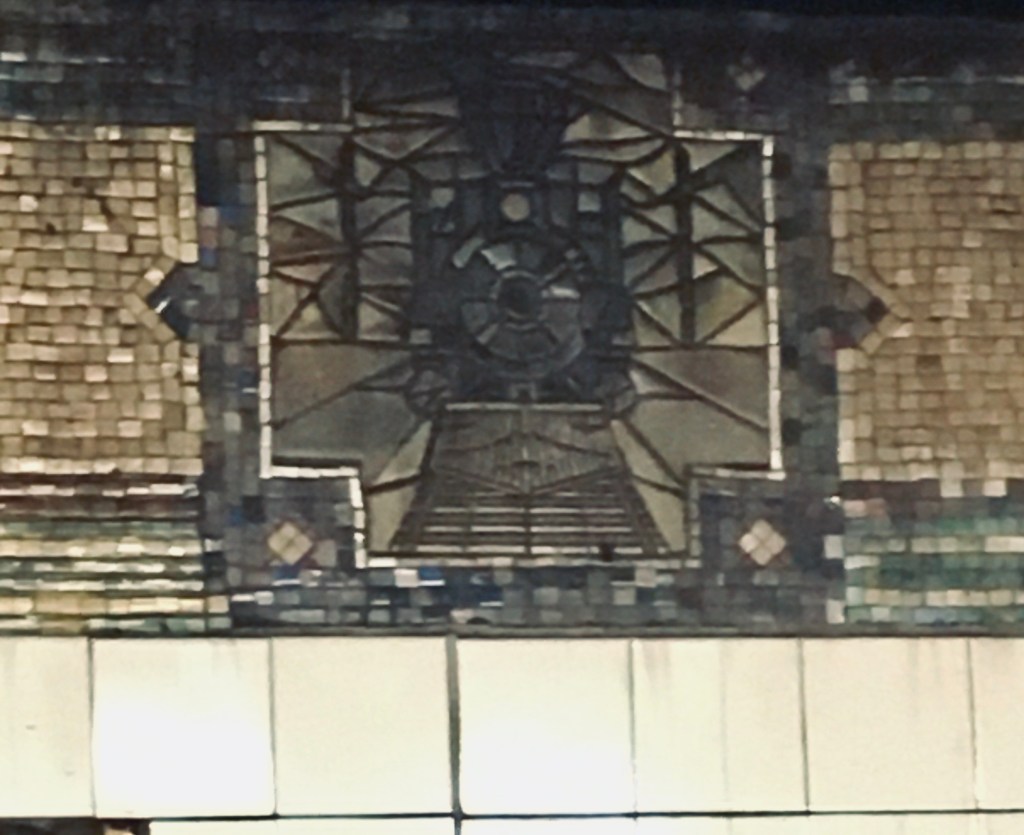
I was also fascinated by the mosaics in the subway stations. Nothing would represent the city for me more than these tiny overlooked details. My friend even said to me that in all the time she had lived in the city, she had never bothered to appreciate the small tesselations of art deco trains and landscapes that adorned the subway station walls. It was such a gaudy yet minute detail that it could only betray the grandeur it represented for the city planners, architects and engineers. It betrayed their desire for this to be more than just a utilitarian train line, for it to be precisely part of the modernist zeitgeist from which New York emerged.
What’s interesting is that this mysterious effect of depth also appears in other places that also have something to do with enjoyment: dating apps. Something I find odd about dating through a dating app is not that people lie in their profiles or even that they set up unrealistic expectations by using their best pictures; but rather that when you finally meet them, they look different. My dates end up being taller or shorter than I expect. They are more manicured here and there. Other times, they’re rougher around the edges. Facial features which I fixated on, like nice lips, turn out to be either over- or under-pronounced. All of this by no fault of their own. One could say people seem different even when they’re the same. The person in front of me is indubitably the person in the picture. And yet difference haunts this interaction. This is uncanny, to me, like déjà vu. I have to think: is it not the case that the person I desire is precisely the one in the picture and not this real one? I make my expectations, my fantasies, based on the pictures, and yet when we meet and my date is right there in front of me in all their concrete selfhood, they look different.

Again, I am not referring to those pictures that are manipulated or filtered but to those that precisely try to show the individual’s “normality”: the ones where they’re smiling with friends or where they’re with their siblings in Santa hats and you can closely see the family resemblance. It’s a type of picture I find amusing because—remembering that this is a dating app—it hints at the fact that what this person deems to be desirable of themselves is precisely their embeddedness in the world. It’s the type of picture that demonstrates that he or she whom I may desire is not alone. And dating apps, from what I’ve seen, can be very lonely.
This experience—where, because of depth perception, because of the new dimensionality I see of a date’s face and body, what I come to see is different from what I have expected and maybe fantasized about—is a coming to terms with difference itself. That difference which is no difference is, I would say, the element of sexuality which is pure disturbance; it is what separates instinct from drive (as in the old Freudian formulation), the sexual needs from the sexual symbolizations in which the needs are carried, like Moses in his basket. I can’t deny that for some of my dates the experience of meeting them has entailed a sort of reset: I’ve had to reconstruct my fantasies anew on the spot. I’ve had to look at them again. I’ve had to re-see them. I’ve had to find anew what it was I liked and re-map it. This activity is difference itself.
Here I am, in front of them to whom I’ve spoken, to whom I have confessed (insofar as one can confess anything in a dating app) my interest, something of my desire, by tapping the “like” button, expecting something which is certainly more than Platonic, something surely physical and precisely beyond symbolic—in other words, here I begin to present a (physical) need. And yet, as Lacan went through great lengths to say, does this need, if it is to be turned into a demand, not have to sift itself through the symbolic order? Does the need not have to fall into language and partake of the signifier where it thereby becomes more than need, where it then shares with desire and becomes a demand (in the coded form we can call “flirting”)? My need becomes mediated by these symbolic supplements. My need is not alone in front of my date. It is hoisted by my fantasies, precisely those I have constructed around their pictures, and by the symbolizations that translate this need into a discourse which was designed to say, “I want you.” And so isn’t here, at the symbolic level, where I have to traverse the language of flirtation and the language of computer code where the cut of difference exists? In other words, at the level where I fantasize, where I build my expectations, where the difference that is no difference puts the whole success of satisfaction in danger because the coordinates of my desire do not correspond to the individual in front of me, through no fault of their own?
The question: does the mapping, in the mathematical sense, which takes my multi-dimensional reality into the two-dimensional world not ruin everything?
 Ruminations
Leave a comment