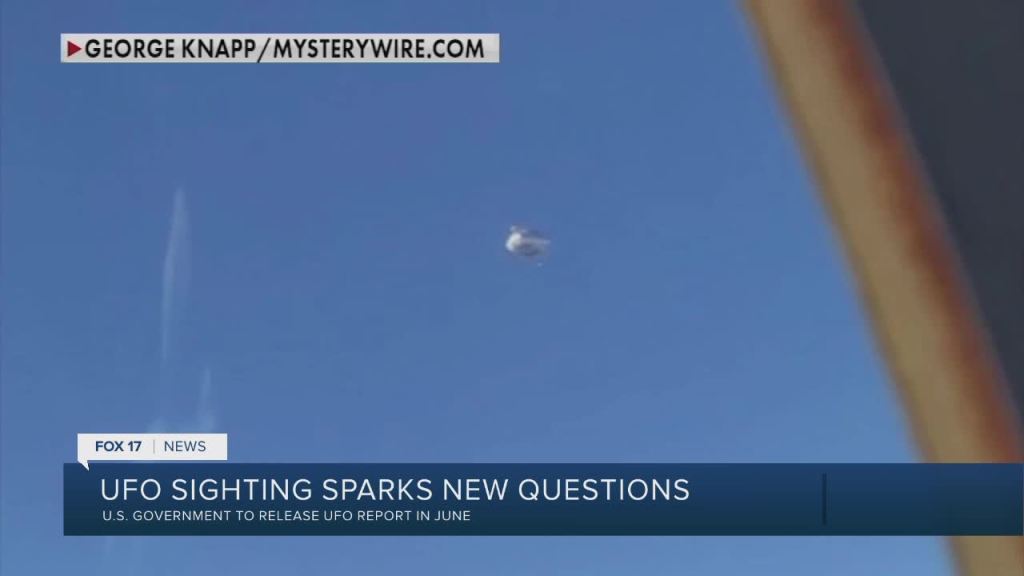
A rhomboid, a flattened oval, a jellyfish, a Tic Tac, a half-moon, a triangle, a sphere, a wedge, the saucer. These are what eyewitnesses in the new Netflix special Top Secret UFO Projects Declassified have said they’ve seen in the skies and which they believe to be UFOs or, as the government officially calls them, Unidentified Aerial Phenomena (UAPs).
The docuseries and the June 25 release of declassified information by the US government raise interesting philosophical and psychoanalytic questions. The release along with the commissioning of a new task force to investigate these strange aerial phenomena seem to imply that the government is ready to enact new levels of transparency on the issue of UFOs. This means that we are now closer than ever to having official government institutions validating the claim that alien beings may have visited us, and more importantly, that there is nothing we can do about it.
The situation is fascinating. Curiosities are stoked. Conspiracies inflamed. But what I find most intriguing is the concept of the visit, the presence here of a seemingly sentient being that is not human. Or that is at least not of this world and/or time. There may be tardigrades in Mars for all we know or frozen bacteria in the cold glaciers of Europa, and they might fascinate astrobiologists and chemists. But what is more radical to me is the idea of agency (or something that seems like that to us) being here in this world with us which is not us. Why? Because it would mark an encounter with a functional, developed consciousness that philosophy has not accounted for, that it may have overlooked in the same way, as Derrida showed us, that philosophy has overlooked the animal. Up until now, all systems of human thought have presupposed that humans were the only conscious beings in the world. Human consciousness has been the frontier of consciousness itself. In the development of AI the question always arises as to whether the AI that we develop ever measures up to us. Our standard of consciousness is our consciousness. It is only humans who partake of both matter and spirit. It is only humans that therefore have free will or who ever get the chance to wonder if they have free will. It is only humans who philosophize; who have self-consciousness, consciousness of consciousness. Friedrich Schelling, the German idealist philosopher went so far as to write that human consciousness could be the consciousness of nature, of the “totality,” itself:
Schelling insists now that “The I think, I am, is, since Descartes, the basic mistake of all knowledge; thinking is not my thinking, and being is not my being, for everything is only of God or the totality” (SW I/7, p. 148), so the I is “affirmed” as a predicate of the being by which it is preceded.
Stanford Encyclopedia of Philosophy
In Schelling’s view, human thought is derived from nature (or God or the totality) since human thought is a predicate of nature. The thought of the human is therefore the thought of nature so that when the human thinks of nature, it is nature thinking of itself. Now, the underlying assumption here is that human thought can be the thought of nature, that it is not its own thought, that subjectivity works within a continuum that also includes natural objectivity. And even if Schelling does not say that this human thought necessarily encapsulates the thought of all nature, this is, I would claim, the working assumption. What else other than the human, in Schelling’s aesthetic view, could write a symphony that revealed the inner, unexpressed mysteries of existence?
The issue of there being another subjectivity is shattering. And already I am taking liberties in saying that these “others” have a consciousness, that they are subjectivities. What exactly can we say about them if not precisely nothing? All we have of their “visits” are the residues they leave behind in the speech of eyewitnesses and abductees, in the very unclear footage we’ve been able to capture, and in technological anomalies. The situation is humorously similar to the psychoanalytic one: there is a hidden trauma somewhere and all we have going for us is people’s faulty memories.
Furthermore, the alien or extraterrestrial is really, as a friend of mine said, a very postmodern entity. It is one that is visible only through traces, is undefined; it has a place in the symbolic order but only as a gap, as pure void not unlike the way in which Kant’s in-itself is also something one postulates as a limit, as an ontological pre-condition which is nonetheless impossible for us to empirically know. The very idea that we will encounter them in some phenomenally substantial sense—meaning that they will come down to us and say hello—is itself already a projection. What I would expect is something like a weather event that we wouldn’t be able to understand, something like what people colloquially call a “glitch in the Matrix.”
As this same friend mentioned, UFOs are fascinating because they are distractions. They remind us of true alterity, of the suprahuman. They can serve as evasions and cynical displacements in our minds. They distract us from our human conundrum. They may even abolish it altogether. Another friend has even said, to follow in this postmodern vein, that the UFOs’ possible existence can be discursively useful for certain ideologies. Atheists could see their absence in holy texts as evidence of religion’s anthropocentric limitations. And the religious may seek to extend their gospels onto the new beings. Or perhaps there may already be a place for them in the existing religious symbolic constellation. (A Catholic could perhaps say they’re agents of evil put there to challenge the faithful.)
In a Foucauldean sense, the very question, “Are we alone in the universe?”—meaning “Are we humans the only beings endowed with self-consciousness and all that this implies?”—could only arise in a historical epoch such as ours: materialistic, scientistic, skeptical of the beyond and of any real spirituality, and post-God. It is precisely the fact that God is Dead that allows us to ask the question without the fear of theological contamination. Imagine asking a man in ancient Greece if he believed in the existence of self-conscious extra-terrestrials. “Sure,” he’d say. “Their names are Zeus, Hera, Apollo, Ares…” (True, Mt. Olympus is technically on Earth, but a careful read at the old legends will show that the place is associated with the heavens—perhaps even the gods had gravity to fear!) Or imagine a medieval nun experiencing an extra-terrestrial encounter and interpreting it as anything other than a religious apparition.
So what do we mean by extra-terrestrials today? What exactly is it that we’re looking at? What are we looking for? Have you noticed how the recently released documentations and footage tell us only that “something is out there” but what it is is beyond us at the moment? There is just something. Carl Jung, as far back as the 1950s, wrote in his Flying Saucers, “something is seen, but one doesn’t know what” (xiii). There is only existence without essence. We are here almost in the language of the unconscious. The alien, like the unconscious, is experienced only as a disturbance. This deep ambiguity is also what makes the alien such an easy target for projection. It’s what led Jung to rather naively postulate that the alien was an emanation of the unconscious. (This could be true but it radically subjectivizes the traumatic nature of the alien itself. For Jung, the human is already traumatized by politics, modern strife and so on, and this trauma produces the UFO sightings.) We humans are almost incapable of talking about aliens without attributing human qualities, expectations, or motivations to them. In a 60 Minutes interview, Luis Elizondo, a former government official within the Pentagon tasked with studying anomalous aerial phenomena, said that he asks three questions when he sees the weird in the sky: “What is it? What are its intentions? What are its capabilities?” (1:47) The second question here is already over-reach. Is this not a psychoanalytic question? How are we to know that they have desires? On what basis do we claim that they are subject to want? Was Stephen Hawking’s fear that they would colonize us not a case of anthropocentrism at its highest? Wasn’t Hawking attributing to the alien what we humans would do because it’s what we have historically done? (And the fact that it was a British subject who said this is not lost on me.) Does that mean they’re capitalists too? That they have ethical norms that regulate their excess? Individuality? Ethical systems? A sexuality that disturbs them? The wonderful and absolutely terrifying thing about aliens is that they could defy logic (as their technology, from what we’ve seen, seems to do already).
Indeed, if they are so prone to being the object of our projections, then how are we to even recognize them?
Hegel, in one of his most readable moments in the Phenomenology of Spirit, writes that when “Self-consciousness is faced by another self-consciousness, it has come out of itself. This has a two-fold significance: first, it has lost itself, for it finds itself as an other being; secondly, in doing so it has superseded the other, for it does not see the other as an essential being, but in the other sees its own self” (§179). The encounter of self-consciousness with another self-consciousness is thus a deeply reflexive moment. In the other, I find myself as other. But my self-consciousness resists that otherness. It resists seeing itself as other. As Hegel continues, “[i]t must supersede this otherness of itself . . . . It must proceed to supersede the other independent being; secondly, in so doing it proceeds to supersede its own self, for this other is itself” (§180). All of which is to say that, in the Hegelian view, self-consciousness is by nature ravenous. It cannot help but see in its other itself. And in seeing itself othered in the other, it seeks to vanquish or sublate the other. But this vanquishing is not destruction. It is consumption. The other is vanquished when we say the other is me. I think that it is for this reason that when we encounter the alien in its pure alterity, we cannot help but assume that something of it must be like us. Something, anything. Otherwise, we feel pure anxiety.
But notice that this Hegelian understanding relies on the presupposition that the other self-consciousness we encounter, is precisely self-consciousness like our own. Even if in our interpretation of Hegel’s famous passages on the Master-Slave dialectic the two self-consciousnesses differ according to class, it still stands to reason that the two are nonetheless bound together by their common humanity. Indeed, the entire point of that passage is to show how, in the Notion, Master can’t be Master without Slave and how Master needs Slave as much as Slave needs Master. They are part of the same Spirit. As Hegel said, “what lies ahead for consciousness [once we realize that self-consciousness is both subject and object, that my self-consciousness is also that of my other] is the experience of what Spirit is—this absolute substance which is the unity of the difficult independent self-consciousnesses which in their opposition enjoy perfect freedom and independence” (§177).
We, however, don’t know whether the alien is a self-consciousness for us in the same way that the Master recognizes the Slave as a self-consciousness. As I said earlier, all we know of the alien are the traces of its presence. The lack of this equality of self-consciousness which Hegel takes for granted in the human case puts in danger the possibility that we would recognize each other. The idea that we could have encounters with these beings is thus woefully optimistic. If anything, this optimism reflects the truth of the Lacanian conception of the subject: “Another subject (and, ultimately, the subject as such) is for Lacan not something directly given, but a ‘presupposition,’ something presumed, an object of belief—how can I ever be sure that what I see in front of me is another subject, not a biological machine lacking any depth” (Žižek, 48). Isn’t this what happens when we speak of the alien having motivations or desires or intentions? Aren’t we presupposing the fact that they too are subjects even as we try to downplay the traumatic nature of that subjectivity?
Let’s turn to Slavoj Žižek who puts it best. In his book In Defense of Lost Causes, Žižek looks at the Western defenders of Stalinist Russia who voiced their support with “utmost sincerity.” These were the ones who at the peak of the anti-Communist fear were willing to go to jail for their convictions, even though it was known that living in Stalinist Russia was a nightmare. Žižek asks “What if . . . such a blindness, such a violent gesture of refusing-to-see, such a disavowal of reality . . . is the innermost constituent part of every ethical stance?” (14) And later, “[d]oes every ethics have to rely on such a gesture of fetishistic disavowal? Is even the most universal ethics not obliged to draw a line and ignore some sort of suffering? What about animals slaughtered for our consumption?” (15) Meaning: does not every universalist ethical system not have some point of error at which it ignores the depth of human subjectivity and possible monstrosity? Think of the Kantian categorical imperative which would not allow a German family during the Nazi era to lie if the Gestapo asked them if they were hiding a Jewish family in their house’s walls. This would be the “fetishistic disavowal.” To be a true Kantian I would have to tolerate even this: no one must act as if lying were universally permitted. Here my ethical calling tells me I must not lie. I fetishize the ethical system and in being ethical I commit a monstrosity: I turn the family in.
Žižek argues with Freud and Lacan that the injunction “Love thy Neighbor” obfuscates the fact that the Neighbor, or really any human other, carries within them this monstrous kernel.
When Freud and Lacan insist on the problematic nature of the basic Judeo-Christian injunction to “love thy neighbor,” they are thus not just making the standard critico-ideological point about how very notion of universality is colored by our particular values and thus implies secret exclusions. They are making a much stronger point about the incompatibility of the Neighbor with the very dimension of universality. What resists universality is the properly inhuman dimension of the Neighbor. This brings us back to the key question: does every universalist ethics have to rely on such a gesture of fetishistic disavowal? The answer is: every ethics that remains “humanist” (in the sense of avoiding the inhuman core of being-human), that disavows the abyssal dimension of the Neighbor. “Man,” “human person,” is a mask that conceals the pure subjectivity of the Neighbor. (16)
Every human subject has an inhuman dimension. But by inhuman we don’t mean the morally reprehensible already. Rather it is what escapes the definitions inherent in humanist “discourse.” It is like the point of exception, the very moment of freedom, which, as in the example Žižek gives from Stephen King’s The Shining, can turn a meek person into a frenzied murderer. This pure point is what complicates the universalism of ethical systems. In fact, Žižek argues that for the ethical system to work, the inhuman dimension in the human—precisely what in psychoanalysis would be the traumatic kernel, the object of pure desire in the navel of the dream—is overlooked. You could say the ethical system represses it. The true ethicist—that is, the ethicist that isn’t like the one described by Greg Pence: “We are Platonic perfectionists in saluting Gold medalists in the Olympics; utilitarians in applying the principle of triage to the wounded soldier; Lockeans in affirming property rights; Christians in idealizing charity . . . and followers of Kant and Mill in affirming personal authority” (quoted in Ethics: the Essential Writings, Ed. by Gordon Marino, Modern Library, 2010, 396)—the true ethicist would have to take a leap of faith. They would have to cover over the presence of this point of inhumanity in the same way, as Žižek mentions, that Anne Frank, seeing nothing but calamity and suffering around her, was still able to write, “I keep my ideals, because in spite of everything, I still believe that people are really good at heart.”
But what if the other we’re talking about is not human at all, meaning that the inhuman core is not covered up by the common humanity that ethical systems much like Hegel’s theory of recognition pre-suppose but is pure inhumanity itself, pure subjectivity, pure escape, that element which is what Lacan would call the “not-all” or Badiou the point of “subtraction”? Hegel again, gives us a colorful description of the abyss that is human subjectivity:
The human being is this Night, this empty nothing which contains everything in its simplicity—a wealth of infinitely many representations, images, none of which occur to it directly, and none of which are not present. This [is] the Night, the interior of [human] nature, existing here—pure Self—[and] in phantasmagoric representations it is night everywhere: here a bloody head suddenly shoots up and there another white shape, only to disappear as suddenly. We see this Night when we look a human being in the eye, looking into a Night which turns terrifying. [For from his eyes] the night of the world hangs out toward us.”
The Philosophy of Spirit (Jena Lectures 1805-6) PART I. Spirit according to its Concept A. Intelligence,
If this was the case then what kind of a leap would our ethical systems have to take in order for them to include our alien visitors? Would one even be necessary or even possible? Isn’t Anne Frank’s ethical statement one that gains its value as a reaction to what she’s seeing? Wouldn’t it become the emptiest of platitudes if she had written this while she had been living a happy bourgeois life? Indeed, what context exists for us to create an ethical system that includes beings whose interactions with use seem more like weather events than actual intersubjective discourse? “Morality,” writes Žižek, “is never just a matter of individual conscience. It only thrives if it is sustained by what Hegel called ‘objective spirit,’ the set of unwritten rules which form the background of every individual’s activity, telling us what is acceptable and what is unacceptable” (48). Can we develop a morality with beings with whom we have never built these “unwritten rules,” when this “objective spirit” does not exist?
In ancient times, extra-terrestrials (in their guises as gods, holy beings, spirits) were included in humans’ ethical system. Sometimes they sat at their origins. Zeus was the master signifier of hospitality, of ξενία. He was the protector of strangers. The suprahuman was part of the human symbolic order. In a way, this was possible because they were similar to humans in their motivations and emotions. Hera agonized over her husband-brother’s philandering. Yahweh of the Old Testament declares Himself a “jealous God” (Exodus 20:2-6). In Christianity, God becomes Man. But the extra-terrestrial of today resists even this community. Those that attempt to make a space for them in our modern, post-God symbolic order like to think them as “scientists.” They say they’re here to study us. (In the humorous case, they “probe” us.) The assumption here is that we’re worthy of study, another bleeding case of anthropocentrism.
There is another point of worrying distance. If we take eyewitnesses’ words at face-value, we hear something that should worry Lacanian theory: when witnesses have encountered them and been able to “communicate,” they often say that the aliens do not speak to them; the aliens seem to make themselves “telepathically” understood. What does this mean if not the collapse of Lacanian psychoanalysis which sees human subjectivity as arising from the subject’s entry into language, an entry which “others” the subject, which moves them from the realm of pure grunting instinct and delivers them into the symbolic realm where meaning can be made of the world? Does that mean the alien speaks to us instinctually? Does the alien, in its communication see into our unconscious? Some say they “hear” them in English but what are they hearing? If the alien did speak extra-linguistically and was able to be understood then that would mean either that meaning itself could be engaged without signs or that everything was always already linguistic. In Lacan, the unconscious is structured like a language, but if the aliens do not speak but make themselves understood without speech, then one can only ask, What happens to the unconscious?
References
“Friedrich Wilhelm Joseph von Schelling.” Stanford Encyclopedia of Philosophy. Stanford University. 18 May 2020. https://plato.stanford.edu/entries/schelling. Accessed 16 August 2021.
Hegel, G.W.F. Hegel’s Phenomenology of Spirit. Translated by A.V. Miller, Oxford: Oxford University Press.
Hegel, G. W. F. “Jena Lectures 1805-6.” Marxists Internet Archive. https://www.marxists.org/reference/archive/hegel/works/jl/ch01a.htm. Accessed 16 August 2021.
Jung, Carl G. Flying Saucers. 1959. Routledge, 2002.
Žižek, Slavoj. In Defense of Lost Causes. 2008. Verso, 2017.
 Ruminations
Leave a comment