I found myself one night researching North Korea. A quick search on Google conjures up images which are eerie: cut-outs of smiling, pudgy figureheads rolling by on 1970s Lincoln Continentals; throngs aligned with a compulsive’s precision along the streets where they wave the bouquets of pink genetically-modified flowers they named after their leaders; the demilitarized zone where the hunky, beefy soldiers of South Korea fiercely stare off their thinner, shorter, North Korean counterparts; and every so often the Dear Leader, who like his family before him, is all too keen to be aesthetically distinctive with his haircut and an oddly businesslike Mao suit in need of serious tailoring.
North Korea is a country alien to all we ideologically hold dear. It is a country, like a trauma, whose existence we don’t always see with full awareness but which brusquely returns when the news throbs with the discovery that they have detonated another nuclear bomb or are otherwise perfecting their ballistic capabilities or have sunk some South Korean fishing boat. They are a trauma in the psychoanalytic sense because though they are inconsequential to the local daily dealings of the Western World they remain a vivid and impacting reminder of political otherness, of what can also be, regardless of whether or not the North Koreans have been economically successful. Their sheer existence provides the exception to the rule that says capital and its cult are the only determinants of a national future.
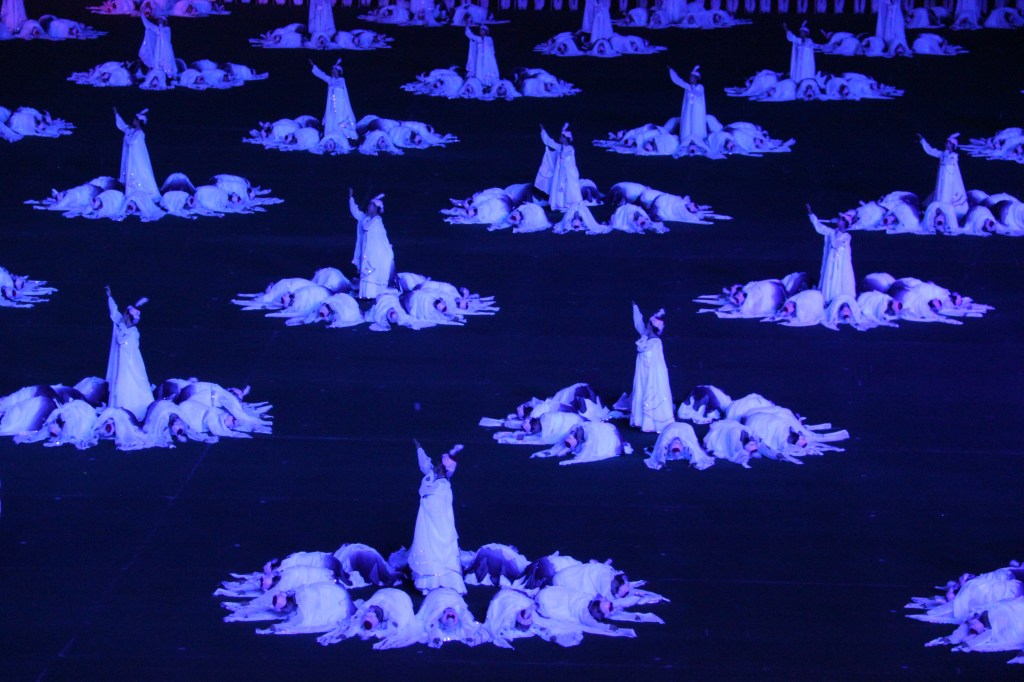
Anyways, I spent a good amount of time browsing and reading and checking out the arcana of that country’s odd ways and I chanced upon a couple of Youtube videos about what they call “The Arirang Mass Games.” These are yearly gymnastics events in which thousands of gymnasts and singers are all choreographed to symphonic state music commemorating everything from the leader, the party, to the success of the socialist paradise, the isolationist Juche idea, and the primacy of the military. On the other side of the stadium, directly facing the main viewing area where the Dear Leader and his cadres would sit, children create moving mosaics by flipping the colorful pages of binders in their hands. The displays are awe-inspiring in the way gigantism is awe-inspiring. Color, light, and multitude seem to be the working methods. There are sashes, hoops, torches, bayonets, towers of trapezing young men and women. Children are occasionally flung like vegetables. All swinging to the martial rhythms of state music. The stadium, the Rungrado 1st of May, is the second largest in the world, but, by today’s standards, is outdated: it is appealing in a very 80s sort of way. Its white scalloped roof arches around the field. It seeks to resemble a magnolia blossom but to me seems more like a pastry. All in all, it is a spectacle designed, as Kim Jong-il said, to “[train] schoolchildren to be fully developed Communist people” (April 11, 1987). And they move with such collective perfection, running synchronized from one side of the field to the other, that the individual is indeed “lost.” You become more entranced by the kinetic grand spectacle than by the excellence of any one individual’s gymnastics—after all it is near-impossible to determine the excellence of one among tens of thousands. The chorus triumphs over the soloist.
And then, at one point, the group of gymnasts moves together to form the shape of the Korean peninsula while the melody of the reunification song, “Arirang,” plays. The gymnasts—women in white hanboks, it seems—move in, swinging over their heads a baby-blue sash. They sway together as a whole which makes the peninsula ripple. It is a peaceful moment, perhaps even beautiful, were it not for the mosaic on the other side of the stadium depicting a political slogan in vibrant colors like the hyperbolic onomatopoeia in a comic book.
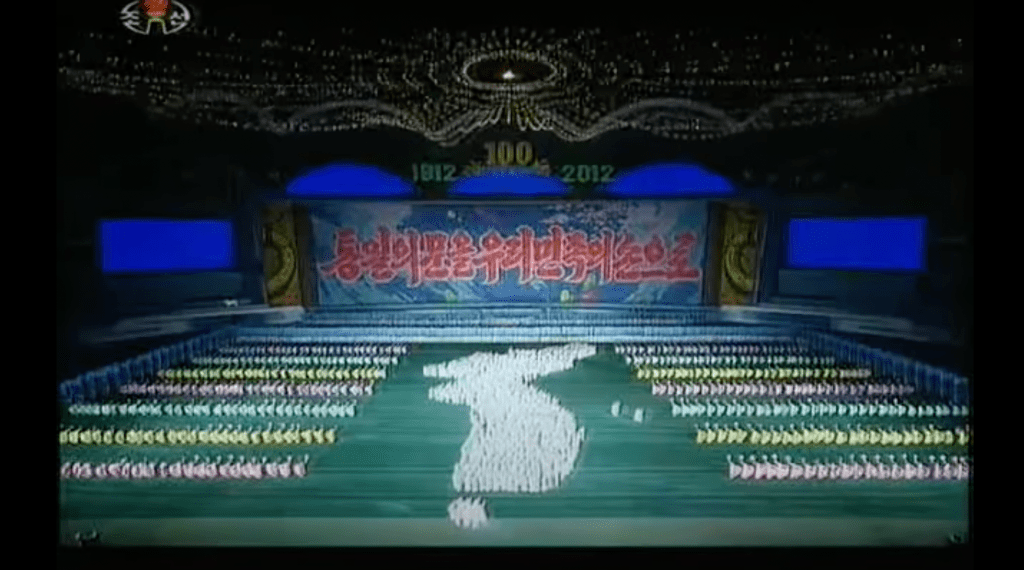
It is at this point, seeing them literally incorporate their peninsula that I started thinking about nationhood and shape. The act is obviously symbolic: it merges the body with the geographic shape of their nation (which here also includes South Korea). I became aware of the fact that the concept of nationhood is ideated, that it is almost entirely removed from direct experience, and that symbolic shows such as these mass games are attempts to bridge the chasm between the ethereality of nation and the corporeality of the individual. Samuel Johnson (in)famously attempted a refutation of Berkeley, who said that matter does not exist because it was ideal, by kicking a stone. One cannot do the same with nationhood.
The definition of a nation is a ghastly enterprise, political at its core, and thus highly susceptible to distortion. A logger in West Virginia who logs from five to five and falls asleep after his ritual trip to the local bar will have a vastly different concept of what “America” is than a poet in a Brooklyn café sipping a bitter IPA and listening to a visiting Congolese band. The cultural gap is large, not least because of the differences in history that have shaped their respective environments and to which they’ve attached their identities. It would be like talking to two citizens from the same country, one from the snow and the other from the desert, and asking them what the nature or essence of the country is: one would say ice-fishing on a lake and the other coconuts in an oasis.
It is experience through which understanding of the world begins, as has been said by philosophers like Aristotle and Kant. This means local subjective experience is the beginning of any knowledge. Taken politically, this also means that on your own, as you live and breathe, you can only ever have a local and subjective experience of your country; that unless you live in every region and every possible community in the nation, communing with and absorbing different ways of life, let alone languages, you cannot understand nor necessarily provide a proper definition of what nationhood entails. There always exists the chance that your country is more varied, more different than the idea you have of it.
Nevertheless, the issue of national definition is important because it often signals the initiation of a political endeavor. Any political movement must postulate some desired future, some outcome. But to do so they have to diagnose the condition of the present. This diagnosis will often depend on precisely what politicians think the “good” or the “essence” of the country is that is worth protecting and maintaining. And so, to name only a few options, they may resort to traditionalism and the idea of nation as the product of inherited wisdom, culture, and/or social practices. Or they may resort to the abstraction of concepts like democracy, representative government, freedom of opportunity. Or perhaps to the imaginary, if ideological, meaning of historical narratives like those of immigration or the success of the entrepreneurial American spirit or the success of American military might.
Definitions of nationhood are thus crucial to political movements, but because these definitions are difficult for us to make, by virtue, again, of the limitations of our experience, we can say that the basis for a lot of politics in this democracy of ours are very philosophically nebulous. Politics nowadays seems more and more a duel of subjective conflicting cultural expectations than a debate, as we would hope it were, between the merits of those abstract, higher values the founding fathers injected into our independence documents.
And yet for all of this, we all agree, perhaps because geographical boundaries are important and incontrovertible facts, that America has a definite shape, very definite visual borders. We see this shape as a sign of the nation. But the shape of the country (or the flag, another sign-symbol) are signs without clear referents, signs that are no longer universalizable in meaning as they may have been in the past, because our concept of nationhood has drastically changed. Not only that, but in true postmodern fashion, the sign has become the locus of intense political vitriol even as its content has emptied. The fight over the sign is often fiercer than the fight over practical issues like hunger or a medical pandemic.
Again, when I step outside my door, I do not see my nation. I see my city. Or no. Not even that. I see my neighborhood. I see the apartments, the usual cars. By driving around I can experience the city, perhaps; by even more driving maybe the state. I can criss-cross its marshy roads, visit towns. I can experience what my skin color and gender and sexuality will allow me to safely experience. Even then it is still not nation.
Furthermore, something happens at the level of the city that doesn’t happen at the national level or even at the state level. My city is itself geographically formless. America and Florida have their usual and iconic shapes. But what about the city of Miami? Looked at from above using satellite imagery, all you see of South Florida are gray masses clinging to the coasts. East and west is divided by the green marsh of the Everglades. There is no visible boundary by which we can easily separate the Palm Beaches, Fort Lauderdale, and the Greater Miami Area. It all looks like one formless metropolis, a body held together by interstate arteries. The very outermost regions of the cities are those pioneering condominium complexes encroaching inexorably onto the natural reserves of the Everglades territories. Little neighborhoods are continuously extending outwards with their cul-de-sacs and playgrounds onto the marsh like tentacles.
If anything, media advertisements, Twitter feeds and Facebook pages prefer to announce the identity of a city like Miami not via its shapeless map, but its architectural icons: the skyscrapers looming over Biscayne Bay, perhaps the famously neon-lit Ocean Drive, or Vizcaya mansion.
It seems to me that the more local the geo-political map (city, state), the more it grounds itself in sensory experience. Meanwhile the more distant the geo-political map (nation) the more likely it is that it will be represented by an ideation, by an image like the geographical shape of a country with no experiential relevance for a regular person.
Now, modern politics are often embroiling themselves in these very vicious wars over sign and symbols. Look at the way Donald Trump used to literally hug the flag. These phenomena can be so attention-consuming that they neutralize meaningful political debate, let alone progress. Indeed, politicians have become quite adept at manipulating the ebb and flow of information exchange for political advantage. And it is not so much that they are distracting from the issues, as burying them altogether. Politicians do not want to sit down and rigorously define nationhood or the social state. They do not want, in an era in which extremism is growing, a seasoned debate on the virtues of conservatism or liberalism or socialism, much less clarify the misconceptions involving these. Politicians nowadays demonstrate a severe allergy to the nuance of real intellectual debate and to the vulnerability it sometimes requires to hold a position and defend it without eliminating the basis of reasoned discourse.
This allergy manifests itself when politicians destroy the etiquette of measured rhetoric by calling a progressive candidate a Communist. Or when the so-called centrists argue that they are the choice that works, the pragmatic choice: an argument that is dastardly because it forces the cynicism of the political profession onto the voter at the ballot box. The pragmatic candidate requests the voter to make a political choice not according to a future ideal but according to a present reality. The voter has thus to accept that the choice that works is characterized by the negativity that this is not the candidate that inspires. They have compromised already at the level of the choice. The exhausted voter, full of the problems of life—children sick, poor wages, difficult hours—is thus forced to sort through the technical tediousness of that candidate’s platform (a tediousness which frankly requires expertise to tolerate) because the candidate’s own ideological stake is nebulous or unknown. In other words, the voter doesn’t know what the candidate “stands for” even while they may superficially agree on policy positions. This can only culminate in demoralization when the candidate, for whatever reason, turns out not to work.
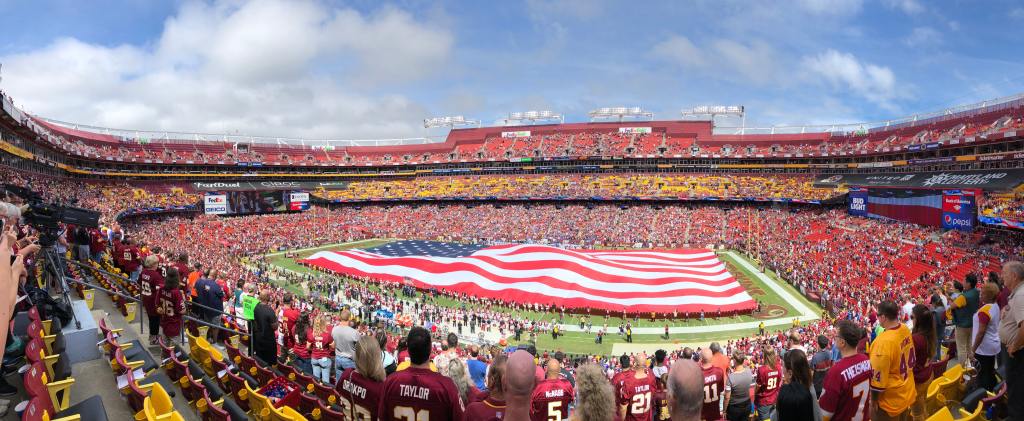
Politicians thrive in this funhouse of sign and image. And while symbols like flags, the shape of a nation, anthems, crests, etc, are not in themselves bad, one has to recognize that they are simply empty. Thus, their proneness to political manipulation. The kneeling by NFL players during the national anthem provides the most visceral example: the kneeling is itself an act of protest to highlight excessive police brutality against Black Americans, but it was branded by opponents as a national anthem protest, thus replacing the focus of a real existential issue with one that is ethereal, hyperreal, and sheerly symbolic. This is not a distraction, but a neutralization. The shape of a nation, like the flag, may simply be just that: an ideation, a figment of thought that we use in order to represent what is inaccessible to our immediate understanding; it can be practically useful in political situations such as in elections when we are forced to pictorially organize the dispensations of power; but it can also be a means of powerful propaganda, as demonstrated by the women in the hanboks waving sashes under the smiling gaze of an autocratic leader.
 Ruminations
Leave a comment