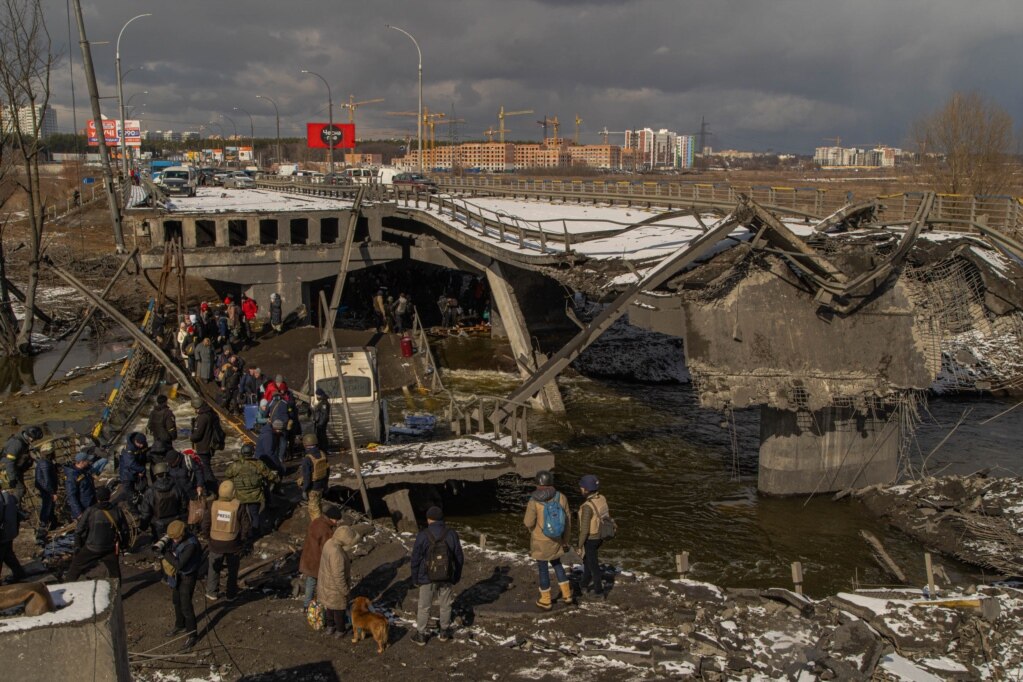
On February 24, the world changed. Images and stories of the war in Ukraine have bombarded us. Pro-Ukraine approval has united the polarized American electorate in ways that seemed impossible. And as Americans start going back to restaurants, weddings, and bar mitzvahs, seemingly believing that America is recuperating from the indelible losses suffered during the pandemic, they are now seeing the total annihilation of Ukrainian cities like Mariupol and Kharkiv.
A typical response to trauma is to seek an explanation for it. There must always be a reason, instigating factors, causes that set the traumatic course of events in motion. Why did Russia invade Ukraine? “The west, and especially America, is principally responsible for the crisis which began in February 2014,” John Mearsheimer says. Others say it was because Russia sought to undo the humiliation of the collapse of the Soviet empire. The reasons are many, some true, some expressly false. But among all of these, the most interesting is one that Mearsheimer criticizes: “The mainstream view in the West is that [Putin] is an irrational, out-of-touch aggressor bent on creating a greater Russia in the mold of the former Soviet Union.” In other words, Putin has gone mad. Putin has made an uncharacteristic and uncalled-for mistake.
To make sense of this, we need a little context. For twenty-two years, Vladimir Putin has been at the top of the Russian political system. He has garnered a reputation for being a cold, ruthless, but nevertheless brilliant strategic thinker. Despite Russia’s incredible corruption and the fact that it is by no means a democratic society, the West has tolerated its authoritarian excesses because it has largely followed the rules of the international global market while gradually paring down its nuclear capability.
In fact, the first McDonald’s was opened in Moscow in 1990, still in the Soviet era. Since the collapse of the Soviet Union and his ascension to power after Boris Yeltsin’s mismanagement, Putin danced with the West, opened up Russia’s oil and natural resource supplies, and solidified his hold on power. While Europe became dependent on Russia’s oil exports, Russia became a powerful geopolitical force. In 2000, Putin brutally suppressed a Chechen insurgency, leading to the installation of a brutal, Putin-friendly dictator in Chechnya who has been accused of serious humanitarian violations and is totally subservient to the Kremlin. In 2014, Putin annexed Crimea, and the world responded with sanctions which, as the New York Times’ The Daily podcast explained, were easily circumvented and whose toothlessness perhaps gave Putin the impression that the West would not care if he engaged in another incursion. And in 2015, Russia protected Assad’s regime in Syria by eradicating Aleppo using a barrage of airstrikes and cluster munitions.
Putin has also engaged in extremely conservative social policy. His actions against the LGBT community are notorious. Putin has called LGBT people pedophiles. In July 2020, amendments to the Russian constitution banned gay marriage. In a speech before he launched his offensive in Ukraine, Putin seemed to express his distaste for the West’s socially liberal attitudes, “attitudes that are directly leading to degradation and degeneration, because they are contrary to human nature.” Ramzan Kadyrov, his Chechen lackey, has gone so far as to say that LGBT people do not exist in Chechnya.
Furthermore, the Russian Orthodox Church has been propped as a Russian ideological nucleus in ways that remind one of the Orthodox Church’s role in the time of Ivan the Terrible. As The Economist states, “Kirill [the Patriarch of Moscow] has declared the current war a Godly affair and praised the role it will play in keeping Russia safe from the horrors of gay-pride marches.” All in all, it seems western democracies and Japan have had an enormous amount of patience regarding Russia insofar as it never stood in the way of global market stability.
Until now.
Putin invaded Ukraine for a second time, and the world seems to have had enough. American public opinion turned against Russia (even though certain sectors of the American electorate had, until then, gravitated towards Moscow), and the next thing we knew, the world locked Russia out of the global financial system. Russia became the most sanctioned country in the world. The new sanctions were aimed at curtailing the enjoyments of hyper-wealthy Russian oligarchs. Unlike those imposed by the West after Russia invaded Crimea, these are being supplemented by western governments actively going after oligarchs’ assets, and we are seeing European governments seizing yachts and villas. From sanctions and financial lockout to the exodus of western business from Russia, Putin’s war will have catastrophic consequences for the Russian economy. Furthermore, if the reports of military losses are accurate, then the war was a military blunder as well (though we should remember here that both the Soviet-Afghanistan War and the Second Chechen war were long and protracted, and we should not underestimate Russia’s capacity to throw lives into lost causes).
So strange has the situation become that many people, including myself, have fallen into Mearsheimer’s trap and said that Putin has gone mad, that something of the last few years of pandemic isolation have skewed his sense of reality. And now that he has rattled the nuclear saber, questions of his sanity have become rather ominous.
Undoubtedly, there is some truth to Mearsheimer’s analysis. It is evident that Russia has seen NATO encroachment as a threat to its national security. But as the majority of criticism of Mearsheimer’s piece has said, there is much that it leaves out, particularly the human dimension: Putin’s own ideological justifications for invasion and the Ukrainian people’s wish to tie themselves to the West. Indeed, what did the Baltic states think when they saw Russia’s annihilation of Aleppo a year after the annexation of Crimea? As Ezra Klein noted in his podcast, it’s getting very difficult to see Putin’s actions as “structurally” motivated, meaning it’s difficult to justify a war of this magnitude.
It is also curious to read that Mearsheimer characterizes the “mainstream” opinion of Putin as thinking that what he wants to do is re-establish the glory of the Soviet Union even though Putin’s speeches and writings are redolent with animosity towards the political boundaries and legal frameworks set up during the Bolshevik experiment. We have to go back to Putin’s essay published on July 12, “On the Historical Unity of Russians and Ukrainians,” which provides the reader with a haphazard and selective history of Russia in relation to its neighbors. There, Putin unambiguously states that “modern Ukraine is entirely the product of the Soviet era.” The Bolsheviks, as Putin argues, treated national boundaries with abandon because, in the end, the project of world revolution was to do away with national boundaries. They set them up arbitrarily because they didn’t matter. (Putin, of course, doesn’t complete the logic.) “It is no longer important what exactly the idea of the Bolshevik leaders who were chopping the country into pieces was . . . One fact is crystal clear: Russia was robbed, indeed.” In Putin’s ideological cosmos, the Bolsheviks gave Ukraine a national identity!
Besides being untrue at various levels, there is something ironic to this belief. What made the Soviet Union a world empire in the twentieth century was precisely the internationalist nature of the Soviet Communist model, the fact that every country, regardless of nationality, could follow in the steps of the Soviet Union and could thus be absorbed into its influence. Its power was in its ideological exports, in the political fraternity at the apex of which the USSR sat. This is not what Putin desires for his new sphere of Ukrainian-Belorusian-Russian influence. Putin’s stringently nationalistic and conservative model is a return to 19th-century style nationalism suffused with reactionary mysticism, a hard sell in Ukraine, even though some parties in the West, like Marine Le Pen’s National Front in France, seek to adapt some of its strategies mutatis mutandis. Indeed, Putin’s project is more in line with those of the tsars of Imperial Russia than those of the General Secretaries of the USSR, a difference that might not seem to have too much of a practical effect, insofar as both aim at domination, but which is at the core of the ideological motivations—the subjective aspect Mearsheimer totally ignores—fueling the Russian aggression.
To return to the issue of his sanity, I am a proponent of taking a dialectical attitude here and of seeing the possibility that for Putin, the most rational option is perhaps the “crazy” one. Indeed, could the use of a nuclear warhead not be a “rational” tactic? Has this war not been determined so far by totally surprising moments, moments that defied the models, the empirical evidence, the expectations: Zelenskiy’s grit and humble valor, Putin’s paranoia and histrionic isolation, the iron soul of the Ukrainian soldiers as they defend their home and re-define what it means to be Ukrainian?
In the span of a month, since the beginning of the Russian invasion, a set of discourses and speculations have arisen which would have been unimaginable three months ago: the fall of Putin, the collapse of the Russian Federation, the “North-Koreanization” of the Russian economy. Along with these discourses, we have seen an ever more belligerent Kremlin. On March 22, Dmitry Peskov, the Kremlin spokesperson, said that nuclear deterrence was an option if Russia faced an existential threat. This is not altogether surprising. But isn’t the problem that Putin sees his regime as being the Russian state? If faced with the collapse of his government and his very way of life, is not a nuclear attack precisely in his best interests? Dmitry Kuleba, the Ukrainian foreign minister, put the stakes of this conflict in the best words I’ve read yet: “If Russia wins, there will be no Ukraine; if Ukraine wins, there will be a new Russia.” If Putin is facing the end of his Russia, is not the most rational thing to do to use absolutely any means at his disposal to delay, if not avoid, that end? What if the real folly would be to think that Russia would go back to its tango with the West without incurring any cost, now that its soldiers have razed cities to the ground, destroyed the dreams and livelihoods of millions, murdered children and their pets, committed horrendous sexual atrocities, and united its neighbors in hatred against them? Strategists like Mearsheimer and Fiona Hill talk of “off-ramps,” of ways to allow Putin to go back on his decision and save face, but the arduous road of Ukrainian reconstruction lies ahead, and the setting up of the parameters by which Ukraine will form its new relationship with Russia remains unsettled. None of this will be easy, and there is nothing but uncertainty ahead, not least because the world situation was not in a good place before the conflict. The pandemic is still around, and climate catastrophe continues to darken our horizons.
 Ruminations
Leave a comment