
Writing is tough business. It is tough to get things down on paper. It is tough to cut them out. It is tough to get them out there to be read. As Hemingway wrote, “A thousand years makes economics silly and a work of art endures forever, but [writing] is very difficult to do and now it is not fashionable” (Green Hills of Africa 109). Hemingway knew, particularly in his last years, that writing is hard. It is very hard and when you feel like you’ve done it right you still run the risk that people won’t like it. “People do not want to do it anymore because they will be out of fashion and the lice who crawl on literature will not praise them.” (ibid.). But for all that bluster about difficulty, Hemingway had one of the most authentic relationships to writing out of all the authors I’ve read. (He’s up there with Flaubert.) His works are peppered with characters that are versions of himself. Many of them are writers and the dramas of which they’re a part unfold around this core which is the writing. See here “The Snows of Kilimanjaro” and “The Short Happy Life of Francis McComber.” As a result, the writing life is part of the drama, it is part of Hemingway’s imagined world. He doesn’t just imagine and then write about it, but the writing itself is what he is imagining. The result is, in a wonderfully Hegelian way, a level of thought about writing that becomes a sort of “philosophy” of writing, one which was very authentic and symptomatic, in the psychoanalytic sense, because he couldn’t keep from repeatedly mentioning it. Let’s look, for example, at the foreword to Green Hills of Africa:
The writer has attempted to write an absolutely true book to see whether the shape of a country and the pattern of a month’s action can, if truly presented, compete with a work of fiction.
This notion of “true” writing appears in Death in the Afternoon and in other works as well. And it makes us wonder as to how an author of fiction could ever declare that what he writes is true. Is not fiction by definition a lie? Not only that but in this foreword Hemingway implies that it is the non-fictional work which is the one that competes with the fictional, as if to say that it is the imagined reality which has to measure up to imagined fantasy. The truth itself is not thereby an objective trait but rather seems a product of the process of representation. (And we must not forget that for Hemingway this means linguistic representation.)
But what in the hell did he actually mean?
What does this notion of “being true” in my writing mean for me if not that I have to look at each of my sentences and ask myself, “Is this a true sentence?” If yes, I continue. If no, then I ask, “What in this sentence is a lie?” Is there such a thing as a “phony” sentence, as Salinger would say? If so, how could we identify them? Are they the ones that say something but what they say is murky? But have we not learned from structuralism down that murkiness is a constitutional element of language? Furthermore, are not rhetorical devices like metonymy and metaphor precisely what “muck up” language and its truth? For David Bourne, the main character of The Garden Eden:
The understanding was beginning and he was realizing it as he wrote. But the dreadful true understanding was all to come and he must not show it by arbitrary statements of rhetoric but by remembering the actual things that had brought it. (182)
And yet, look at this from the same book:
“Where I’m holding you you are a girl,” he said. He held her tight around her breasts and he opened and closed his fingers feeling her and the hard erect freshness between his fingers. (17)
Obviously, the “freshness” stands for the woman’s nipples. But for an author as allergic to this type of replacement, Hemingway seems to have cheated. Freshness is an abstraction which moves us away from the carnality of the moment. It does not seem like an “actual thing.” Isn’t it safe to assume that the “true” sentence is the one that doesn’t have this type of excess? The one that simply says that what is is? Or should we say, on the contrary, that this sentence is “true” in that it locates successfully the abstract notion which is the meaning or essence of what he wanted to relate of this intimate moment between two characters?
Regardless, the benefit for me of following Hemingway’s attitude towards writing is that it makes me honest. I think to myself: Am I writing what I believe is true? Am I writing as if I were speaking? This does not, of course, mean that one’s writing becomes simple and easy to follow. No writer since Joyce has made me slow down in my reading more than Hemingway has. But it does mean that when writing you do not complicate. There is a bit of stoppage that should happen before putting down a word. Some of it may be a concern with clarity but it is also about aptness, cleanness. As David Bourne has it:
. . . it is all very well for you to write simply and the simpler the better. But do not start to think so damned simply. Know how complicated it is and then state it simply. (ibid. 37)
To make this clear, let’s look now at a sentence from a wholly different novel, one from a previous century: Dostoevsky’s Demons, as translated by Pevear and Volokhonsky.
He was, for example, greatly enamored of his position as a “persecuted” man and, so to speak, an “exile.” (7)
Is this not the type of sentence uttered by an overly garrulous voice that wants precisely to not say something? That uses “for example,” “greatly,” and “so to speak” as forms of delay and deferral? As empty gestures?
How would Hemingway have written this? Perhaps:
“He liked his being persecuted and his being an exile.”
This may seem like a simplification of the Dostoevskian line, surely, but in my example there is already a key Hemingwayan trait: repetition. Furthermore, it also sets the sentence up for another conjunction like “and” which is how Hemingway often speeds up narrative action (thus forcing you to slow down your reading) and balloons the sizes of his sentences. The declarative tone also hides the ambivalence present in Dostoevsky. You could say it represses it. In fact, if in Dostoevsky the ambivalence can’t help but be textualized, written, then this ambivalence is “symptomal,” what Freud would call the return of the repressed. In Hemingway, it is simply and totally repressed.
This notion of “repression” is not new to anything having to do with Hemingway. And this is not just because of Hemingway’s troubled history and psyche or the fact that he was a literary man at the time Freud was changing the way people thought about the mind, but because of the way his audiences have come to appreciate his style. This was in part Hemingway’s own fault. In Death in the Afternoon, he wrote:
If a writer of prose knows enough about what he is writing about he may omit things that he knows and the reader, if the writer is writing truly enough, will have a feeling of those things as strongly as though the writer had stated them. The dignity of movement of an ice-berg is due to only one-eighth of it being above water. A writer who omits things because he does not know them only makes hollow places in his writing. (Quoted in Ernest Hemingway On Writing, 77)
This is his famous passage on his style of omission. It’s important to take this apart piece by piece. It’s not self-evident. The writer has, first, to omit what they know. So this is not a random or aesthetic omission. It is an epistemic one, one that actually puts a tremendous responsibility on the author to have certain “knowledge” of the world. Secondly, if the writer is writing “truly” enough these omissions will be perceived by the reader and just as strongly as if they hadn’t been omitted. The omission is thus no omission. The Hemingwayan text reduces itself to a minimum which is no minimum. Last, Hemingway implicitly compares the process of writing to the “dignity” of a moving ice-berg. Of course, this dignity is itself metaphorical and I can’t help but see it as meaning some sort of aesthetic value. In this short passage, we thus have three ideas—omission, truth, dignity—which Hemingway consolidates into some relation with each other, though how they relate remains unclear. Does the writer have to write “truly” before the omissions or does the the truth arise as a function of what is omitted? And what of this notion of dignity? What exactly is it that Hemingway finds dignified in his style of writing?
The stroke of genius in Hemingway—though this is a doubled-edged sword if there ever was one—is that he trusts his reader too much. Hemingway recognized that we readers have to meet the writer halfway and that the anxious writer disregards this. The anxious writer tends to overextend themselves onto the reader. The reader must always supplement the text, and this is because language does not totally cover the void of meaning. In other words, while we can communicate in language, meaning itself can syphon off precisely because language is not reality in toto. If it were, we would have neither Lacanian psychoanalysis nor Derridean deconstruction. As both of these theories have postulated, the addition of more and more words to any text does nothing but defer the possibility of the plenitude of meaning. Hemingway’s gambit is totally on the side of the reader. Let the reader build the connections in the writing themselves. In a way, I’d claim that it‘s not that the reader feels the omissions as strongly as if they had not been omitted but rather that the reader feels the placeholder of the omission itself. The very terseness of his style seems to signify that there is something beneath it. This is just like in Lacan: the signifier, the word, is a construction, meaningless and arbitrary, that we use to cover over the gaping void of the Real, which is inscrutable. The signifier is a fake thing that covers over an impossible gap. For example, the phrase “my cat” is a set of signifiers that may signify my cat in the context of my speech, but the words do not come close to all my cat means to me. Indeed, my attachment to my cat may be such as to be incapable of being written about. Hemingway’s work is thus one that actively allows the Real to yawn into the text.
The other side of the coin is that Hemingway exposes himself to serious misfire. Sometimes, there is no “behind the words.” Take Green Hills of Africa again. This is, for me, a tiresome and repetitive book. The African hunt, the book’s main subject, was what I was least interested in. The landscape is continuously described and though Hemingway is quite successful at it—meaning that the reader can “see” the landscapes and so on—I’m not sure that the most granular of descriptions leads us to the truth of what being in Africa is. The plenitude of meaning, again, simply will not be reached by language. Hemingway betrays this point himself when he writes, “The country was so much like Aragon that I could not believe that we were not in Spain…” (146). Here we have to ask, Well, what was the purpose of all that natural African description, all that “truth,” all that having “known” the place, if at the end of the day, you’re just gonna say it’s like Spain?
The other risk Hemingway runs is that of being ideological. How can Hemingway the writer ever know that what is true is true? Here is where he runs risks of sounding dated and where Hemingway most exposes himself to charges of insensitivity, discrimination, racism, and misogyny. Take another episode from Green Hills of Africa:
Then I was holding P. O. M. [Pauline Pfeiffer, his wife] tight, she feeling very small inside the quilted bigness of the dressing gown, and we were saying things to each other. (290)
Hemingway writes this after a successful kudu hunt that had earlier eluded him. What’s interesting here is the suppression of the romantic moment. It recalls the fact that Hemingway’s romantic couples are awfully pasty. The men are strong, broody and silent, the women neurotic, talkative and infantile. Here Hemingway reunites with his wife at a climactic moment in the book, and yet all he writes is that they “were saying things to each other.” It’s written as if Hemingway was evading the moment. Wouldn’t this type of portrayal of the man—stoic, terse, silent and filled with psychological burden—be precisely the “truth” of the early twentieth-century male imaginary in America? Doesn’t Hemingway’s style particularly expose him to his and his time’s prejudices?
The thing about Hemingway’s style is that it relies too much on this gesture of letting the reader totally supplement the emotional impact of the narrative. Hemingway’s narrative distance, much like Gustave Flaubert’s, forbids him from using his narrators and/or characters from interpreting the significance of events in their stories. The characters register the events and often express their emotions in response, but Hemingway truly trusts that his readers will do the majority of the work.
A story like “Hills Like White Elephants” is possibly the best example. The first time I read this story as a high schooler I had no idea what the story was about. (In the story, a man wants his partner to have an abortion, but this is never stated.) A female classmate of mine, however, did know and I remember that when called on to give us the secret of the story, my classmate relied on a metaphor: “The woman has a bun in the oven,” she said. Indeed, the gambit in cutting out too much is the fact that there may be words, perhaps excessive words, phrases, which seem totally unnecessary but that are actually integral precisely because they’re unnecessary. Again, see the example from Green Hills above. We perhaps know full well that the lovers’ exchange is excessive. It’s meaningless. It’s raw emotionality. It’s thus a prime candidate for cutting out of a story. But isn’t it as such, as excess, that a lovers’ exchange establishes the authenticity of the love between two lovers? Aren’t the little nicknames lovers give each other the mark of the truth of a loving relationship because only people truly in love can bear such stupidity? The thing about the lovers’ exchange is that even if it adds nothing when it’s there, subtracted, it takes everything.
Again, I would even say that Hemingway is evading something. This omission here masks a Real point, in the Lacanian sense. And this is where Hemingway’s so-called ice-berg theory meets psychoanalysis.
I’ve often taught Hemingway’s style as the style of trauma. There is some traumatic kernel, some point of impact in the characters’ past, but it can never be talked about. (Jake Barnes, for example, in The Sun Also Rises seems to have a groin injury, a castration even. Similarly, Maria in For Whom the Bell Tolls is the victim of wartime sexual violence.) The trauma can only be orbited around. Language can only pass by it. It may come close but it cannot touch it. Hemingway omits what other authors, perhaps to their discredit, would force their texts to discuss.
When I stopped writing I did not want to leave the river where I could see the trout in the pool, its surface pushing and swelling smooth against the resistance of the log-driven piles on the bridge. The story was about coming back from the war but there was no mention of the war in it.” (A Moveable Feast 72)
The war—the real—is absent from the story—the symbolic. But it is the war which “disturbs” the story. The war haunts Nick Adams without his having to say anything about it. In some senses you could maybe say that what is unsaid in Hemingway is the story’s unconscious, that elusive force which is there in the symbolic, but which is in-itself impossible to observe. (Confer Lacan: “The unconscious is structured like a language,” “the unconscious is the Other’s [the symbolic order’s] discourse.”)
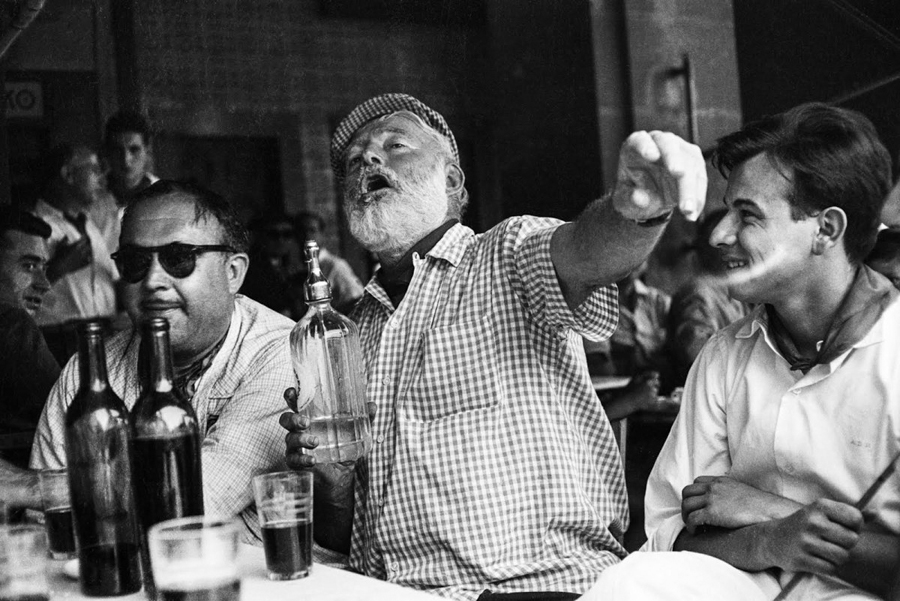
The tragic thing about Hemingway is that he was very serious about his idea of what writing style should be even though it was his very commitment to that style which did not let him write well about it. Hemingway likes to stay in the lateral, in the superficial. But what if what he wants to write about—say, his style—is by nature profound? What if what he wants to write about resists a lateral way of writing? Isn’t this what happens when he writes of writing “truly”? Isn’t this demand for art to have a relation to truth one you would also find in the aesthetic writings of a Schelling or a Schiller? But then what is art? Is Hemingway committed to a philosophy of disclosure à la Heidegger? In A Moveable Feast Hemingway writes, “you could omit anything if you knew that you omitted and the omitted part would strengthen the story and make people feel something more than they understood” (71). Here, it sounds as if what Hemingway privileges is feeling over understanding, thus putting him solidly in the old Romantic camp. And yet there is, to my awareness, no place where he systematically tells us the consequences of this position, a full aesthetic of literary writing. In other words, he tells us a method, a praxis, but no theory, so to speak. He tells us to omit so that in the omission the reader will feel the truth of the writing all the more, but he never tells us the why nor the what—he wouldn’t tell us, for example, why Proust is wrong to balloon his novel up to 4000 pages. Indeed, is Hemingway even making a claim to aesthetic universality or is he simply justifying himself?
And it is precisely for the fact that Hemingway is vague that his stance on writing is so authentic: it bears the structure of pure belief, of faith (thought this doesn’t mean it’s correct). For what is belief if not a subjective position you hold in light of some uncertainty, some unknown? Isn’t Hemingway in his characteristic vagueness making a move like Anselm of Canterbury where one has to believe to understand? Credo ut intelligam? You have to first be true to yourself to then write. And perhaps because Hemingway’s theory is so much like a belief, so irrational at its core, that it is difficult to teach it, to pass it on. As Dorothy Parker wrote, “His is, as any reader knows, a dangerous influence. The simple things he does look so easy to do. But look at the boys who try to do it” (Quoted in Dearborn 247). Compare Hemingway’s position to Joyce’s in Portrait of the Artist where Joyce brings up Aquinas as the model for his aesthetic. Doesn’t this bringing up of an influence contaminate his aesthetic with a medieval “program”? Is Joyce’s work a subset of medieval aesthetics as Umberto Eco tried to show?
Many creative writing departments have taken to almost ideologically spouting off that “showing and not telling” is the way to good writing and they would look at Hemingway as the author that exemplified the success of this platitude. The problem is that this confuses proximity to action and character, of which Hemingway was a master, with “showing.” Hemingway loved to get extremely close to his characters. And so he does “show” with great precision and patience what they do at a very granular level. But this proximity also meant “showing” repetitive and often confusing tasks, such as Robert Jordan’s tying of explosives to the bridge in For Whom the Bell Tolls. It also meant getting right into a character’s head, where there was nothing to show but the character’s mental and verbal meandering (through narrative techniques like free indirect discourse). Proximity and “showing” meant getting close to the surface. Perhaps they meant nothing more. It’s almost as if he were reflecting a Hegelian truth: contra Kant, surface is all there is, appearance is pure being. If you want to get deeper, beyond the object, you have to think about it. You have to mediate the object, interpret it. The in-itself of the object is precisely that dumb thing in front of you. For you to access its deeper, ideal, abstract essence you need to start using your Reason. Unfortunately, the “show don’t tell” dictum seems to accord quite well to our distracted, attention-addled, consumerist societies. Novelists today, forasmuch as they continue to write beautiful and engaging books, are more and more leaving the task of hard and edged thinking and critique. The result of which is that many authors today are commercial authors that pantomime being literary, where, ironically, Hemingway was a literary author who pantomimed being commercial.
As a last word, what I ultimately do appreciate is the attitude, the commitment to a discipline of writing, which, for all its limitations, is self-assured. It has a certain desire.
What we can distill is the self-criticism, the obeisance to the shadows of language. There is just something beautiful, some effect when in reading we see that the language misses the spot and yet, in having done so, hits. And we come out of it thinking nothing more needed to be said.
References
Dearborn, Mary V. Ernest Hemingway: A Biography. Vintage, 2018.
Dostoevsky, Fyodor. Demons. Translated by Richard Pevear and Larissa Volokhonsky. Alfred A. Knopf, 1994.
Hemingway, Ernest. A Moveable Feast: The Restored Edition. Scribner, 2010.
Hemingway, Ernest. Green Hills of Africa. 1935. Scribner, 1963.
Hemingway Ernest. Ernest Hemingway on Writing. Edited by Larry W. Phillips. Scribner, 2004.
Hemingway, Ernest. The Garden of Eden. Scribner, 1986.


 Ruminations
Leave a reply to jchakko Cancel reply